Wednesday, August 31, 2016

No, I'm just looking!

Is the iconic secret agent transforming both as a figure of desire as well as the figure who desires?

The sensuous secret agent is past 50, and is not done yet. With its all twenty-four releases under Eon productions, Ian Fleming’s iconic James Bond with a pre-script 007 has continued to seduce women as if there is no tomorrow. Providing a visual guarantee of the maleness of the secret agent, from Dr. No to Spectre, the female characters have been treated with disdain by James Bond. No wonder, Bond has been personified as a guilt-free voyeur with a license to seduce and bed women, and if need be kill them too. Without doubt, the legacy of the most-wanted secret service agent has been built at the expense of women of all hues.

How has a character, who has been accused of sexism, endeared itself on the silver screen for five decades? Having studied the James Bond franchise for over a decade, Lisa Funnell has come up with a nuanced but complex understanding of gender, sexuality and female representation in the immensely successful series. Pulling contributions from over two dozen established and emerging scholars, the compilation provides breadth and depth that goes beyond the assumption that the masculine genre of action is created by and for men. In reality, however, Bond has been scripted both as a figure of desire as well as the figure who desires. More than mere beautiful objects, the Bond girls from Ursula Andress to Monica Balucci, have given momentum to the story with their often underrated skills in armed combat and espionage knowledge. 

Funnell, a professor at the University of Oklahoma, has often been asked how being a woman and feminist has she followed aggressive heterosexual masculinity and consequent suppression of women by James Bond. Positioning herself in the complex space defined by the patriarchal nature of film, she discounts the problematic nature of the films in favor of consumption of male culture which defines female fandom. Why should gendering of consumptive practices work to delimit pleasure? In the Bond fantasy world, both good and bad women, have a pivotal role to play in furthering the narrative. These characters can easily be viewed as symbols rather than individuals, their position being a reflection of their disposable physical attributes as mere functions of the narrative. No surprise, therefore, that the Bond girl is usually characterized as being independent and willful. 

Does it mean the Bond stories reflect a progressive view of women’s sexuality? On the contrary, the manner in which James Bond ends-up possessing the girl(s) reflects a traditional, and culturally problematic, male fantasy of women’s sexuality. Sample the iconic scene of rising Ursula Andress out of the surf in a white bikini in Dr. No. ‘What are you doing here? Looking for shells?’ she asks. Without missing the gaze, Bond replies: ‘No, I’m just looking’. Sigmund Freud would view such ‘gaze’ from the notion of scopophila, creating a voyeuristic viewing situation in the darkness of the theatre. In drawing greater sexual freedom for women, Ian Fleming extracted greater sexual opportunities for men. And, it has paid dividends at the box-office.   

The social consequences of the perpetuation of gender stereotypes have far from clearly understood, and neither has it been easy given the complex nature of patriarchy and feminism. The book explores tensions between the progressive and the conservative viewpoints, offering scholarly perspectives on the representation of women in the franchise. 

There is an interesting twist to the tale, though. The first Bond novel was published in the same year as the launch of Playboy, lending credence to the assumption that the story emerged in the context of mass-market pornography. It captured the emerging consumptive characteristic of post-war Western Europe and North America. And, there hasn’t been any looking back since then. If graphic account of sex wasn’t enough, the Bond girls were given sexually suggestive names - the most risqué and famous being Pussy Galore, played by Honor Blackman in Goldfinger (1964). Plenty O’Toole and Octopussy were other sexually suggestive names for Bond girls in the series. 

Ever since the iconic character was created, socio-political developments have shaped the depiction of women in the franchise. The book captures the influence of feministic undercurrents on the franchise through the decades, and makes for serious scholarly reading. The most significant change being the transformation of Playboy in recent months. With the magazine having started covering its girls, so has James Bond responded by bedding few women than his predecessors. Spectre, the latest Bond flick, has Daniel Craig in more serious romantic relationship.   

For His Eyes Only
by Lisa Funnell (Ed)
Wallflower Press, UK
Extent: 309, Price: $30  

This review was first published in Deccan Herald on Aug 28, 2016.

Saturday, August 27, 2016

The inability to think of the unthinkable

Public response to climate change is caught between the polarities of widespread denial and overt activism.

Like tigers in the Sundarbans, where the beast remains elusive but not its footmarks, climate change is seemingly everywhere and yet found nowhere. Despite its improbable though astoundingly real occurrences, the climatic events have been restricted to our fleeting consciousness. So far, only 19 countries have inked the non-binding Paris Agreement to limit global warming to well below 2°C. All this is taking place while social media has made climate change research a part of the public discourse. The aim is to trigger action towards a credible policy response. Far from it. Discomforting as it may be, the eerie silence around the dangers of climate change has come to rest on the skewed awareness that we are all living in a ‘new normal’.

Amitav Ghosh questions this notion and our inability to think about the lurking dangers of climate change, and challenges the uniform expectations rooted in the ‘regularity of bourgeois life’. Need it be said that unstinted faith in such perceived regularity has driven the modern world to the point of derangement. It follows that we cannot recognize the environmental problems created by our way of life. As every individual is incentivized to improve his or her standard of living and the state is driven by the capitalist model of double-digit growth, what will drive us to exit the comfort zone of this ‘new normal’ remains a vexed question.

Being a celebrated story-teller himself, Ghosh wonders why climate change has not been taken seriously by fiction writers and literary journals. Although the subject has figured obliquely in his own writings, he contends that a broad imaginative failure arising out of a personal predilection to climate change has prevented writers from negotiating the currents of global warming. The Great Derangement is thus a call for writers to pull climate change out from the realm of scientific research into the literary domain such that contemporary culture may find it easy to deal with it. After all, the climate crisis is as much a crisis of culture as a crisis of the imagination, an inability to think about the ‘unthinkable’.

There is a difficulty in accepting such consideration. Research shows that people do not learn about climate change through personal experience or act on the issue unless it evokes strong visceral reactions. Why would people think about climate change, which involves thoughts on death and their own mortality? Most individuals rarely take seriously even predictions on water scarcity. No wonder then that a film like The Day After Tomorrow, with its depiction of glacial meltdown leading to a submerged Manhattan, served merely as action-movie entertainment and did not lead to serious climate discourse among movie-goers.   

The literary mainstream too has remained on the margins of the crises and has been restrained on the forest fires, cloudbursts, tornadoes and tsunamis that have been pounding our world with ferocious regularity. As public response to climate change is caught between the polarities of widespread denial and overt activism -- which is also under surveillance by the military-industrial complex -- literary minds do have the power to free society from the shackles of cultural cognition and motivated reasoning. Ghosh argues that there can be no compelling period in human history to recognize the urgency for such an engagement.

The Great Derangement views the history and politics of climate change through personal stories. It is a refreshing take on a subject that has just about moved from the post-scientific consensus stage to a pre-social one. Scientific knowledge in itself is never socially or politically inert, particularly when it prompts changes in people’s beliefs or actions. However, it takes time for social acceptance to emerge. Only by acknowledging and addressing this underlying subtext of climate change can the cultural schism be bridged.

The author’s anxiety on the subject of climate change comes through clearly in this erudite narrative. But science does not have the final word when it comes to bringing about a shift in our culture practices. Even the scientific ‘proof’ of a causal connection between smoking and lung cancer has been hard to establish. Science can only describe the problem; it is for cultural processes to guide social and political change. Rather than forcing people to acquiesce, the better goal would be to prepare society to address the full scope of the climate change issue.

Written with ecological passion and literary flavour, The Great Derangement is an absorbing narrative on the subject, the impact of which is getting closer with each passing day. Shorn of scientific jargon, it is an interesting exposition on the most urgent task of our time.

First published in The Hindustan Times dated Aug 27, 2016.

Friday, August 26, 2016

The voice of the vanquished

It is human nature to find everything about the victors virtuously rosy, and everything about the vanquished a vicious black.

Mythology and history have often been unkind to the losers, as these are either written by the victors or by those who eulogize their heroes. Over time, such exaggerations acquire a reality of their own, told and retold as the ‘truth’ of the times. After all, it is human nature to find everything about the victors virtuously rosy, and everything about the vanquished a vicious black. And, the vanquished are forever the whipping boys of posterity, as the Kauravas have been since the days of the Mahabharata. And, the title of the chief villain of the epic war has been bestowed on Duryodhana, the eldest among the hundred siblings borne to the blind King Dhritarashtra. Rarely has anyone questioned the veracity of the story, which has been passed on from one generation to other. But if the narrative strength of the epic lies in its multiple renderings, should Duryodhana not be given a chance to make a case for himself? 

Known to constitute the ruling and the military elite, it is ridiculous to assume that the kshatriya parents would knowingly consider Duryodhana as a chosen name for their child, as it means the one who makes wrong use of weapons. In reality, the crown prince of Hastinapur could not have any other name but Suyodhana, the one who is adept at wielding weapons. And, there is hardly any account of him proving it otherwise. It seems the chronicler of the epic saga chose to identify the crown prince otherwise, a name that eased in anointing devious sub-plots aimed to demean his character. Subjecting mythological facts to logical reasoning, V Raghunathan brings the much maligned prince to life to narrate his side of the story in Duryodhana. 

Candid in his confession, the protagonist argues that if the Pandavas were as good as they have been painted to be then the Kauravas had their share of good deeds as well.  The epic war is stated to be the handiwork of Duryodhana whereas in reality it was on account of the Pandavas staking unsubstantiated claim to the throne, while none of the brothers were sons of Pandu as the scheming Kunti had made everybody believe. Sage Vyasa had himself put the facts across in the epic: Yama, Vayu and Indra were the respective fathers of Yudhistra, Bhima and Arjun whereas the younger two Pandavas, Nakula and Sahadev – born to Pandu’s second wife Madri – were also not sired by Pandu but by the renowned physician twins, the Ashwini Kumaras. Given the non-Kuru lineage, Duryodhana had a far greater right to reject such devious claim than the Pandavas ever had to make that claim in the first place. 

It is tough not to believe Duryodhana who brings the already known facts to light. In doing so, the protagonist builds a compelling case for the version of the epic being flawed because the facts were misrepresented to disfavor the Kauravas. It is equally true that the story may not have been fascinating had it been painted merely in white and black. The Mahabharata is not one story, but there is story within a story and each character is not what it may seem to be. Fact and fiction blend flawlessly, making it quite a task to separate the grain from the chaff. 

It is often believed that just because Krishna fought on the side of the Pandavas, they must have been in the right. If that be so, why did Krishna’s elder brother Balaram, along with many other noble souls like Karna and Jarasandha chose to side with the Kauravas if they were pure evil? Presiding deity he might be but Krishna had his share of ‘grey’ in the epic when he had partnered with Bhima and Arjun to murder Jarasandha by stealth. Duryodhana equates his attempt to kill Pandavas with Jarasandha’s murder as pre-emptive strikes for the protection of their respective kingdoms, but wonders why his attempt was singled out as a crime?    

Duryodhana’s version of the epic is iconoclastic, engaging the reader's attention to the bygone characters and incidents from a fresh perspective. The idea is not to rewrite the great epic but to pick essential lessons from it. Says Duryodhana: ‘We might ascribe disproportionate credit or disgrace to ourselves for our successes and failures whereas the truth is that, we are bit actors in a grand scheme of random events.’ Afterall, like the Pandavas, Duryodhana and his kin were the product of their times over which they had little control.

Duryodhana leaves the reader with a volley of intriguing questions to ponder over. Was it my fault if Yudhisthira chose not to heed his brothers’ advice against accepting the invitation for a game of chauper? Was it my fault if Yudhisthira considered his wife to be his property (though it belonged to his other four brothers) and wagered her in the game of dice? Was it my fault if Shakuni was a better player of chauper than Yudhisthira? Am I to be faulted for winning back Indraprastha by strategic statecraft rather than open warfare?  Why history doesn’t credit me for upholding the personal liberty of the Pandavas by sending them to exile? Why I’m not being credited for letting Draupati her freedom with her good-for-nothing husbands? 

The Mahabharata has been told and retold for thousands of years. The epic has engaged readers and scholars to understand the story from the perspectives of its secondary characters. V. Raghunathan makes a convincing case from Duryodhana’s perspective, which is highly absorbing and immensely thought-provoking.  It adds yet another dimension to the labyrinth that is the Mahabharata, 

Duryodhana
by V Raghunathan
HarperCollins, New Delhi
Extent: 307, Price: Rs 350  

This write-up was first published in Speaking Tree dated Aug 7, 2016.          

Saturday, July 23, 2016

Of paradox and possibility

While the collective power of many small (apolitical) efforts to bring about change is acknowledged, what gets missed out is the fact that development is inherently a political process.

India is a land of paradox: if there is poverty amidst prosperity then hope can be traced amidst despair too. Despite being an increasingly unequal society that produces real victims and genuine tragedies on a daily basis, it inadvertently leaves people to create possibilities for their own emancipation as well. With humane development far distanced from a sizable population, individual creativity is innovating new pathways for leftovers of the society to tread on. For millions trapped in the downstream economy of deprivation, ordinary folks are scripting extraordinary tales of bringing basic elements - potable water, safe food, and fresh air - within peoples’ reach.

Elemental India is an inspiring journey through this landscape of paradox and possibilities, a compendium of stories weaved together to reflect the essence of pancha mahabhuta – five elements that constitute nature. Within the geographical bounties of the sub-continent, a wide array of fascinating survival options are being created by enterprising individuals and institutions to keep the ‘five elements’ in harmony. Embedded in this quest for alternatives are personal journeys of some of these individuals in search of a meaning of life.   

Umendra’s crusade for organic agriculture in Punjab; Kanhaiya’s relentless pursuit for water in Rajasthan; and Pinki’s tirade for women liberation in Bihar are few of those stories, offering counter narrative to the dominant discourse on development that hinges on industrialization. That there is an alternate way of life and an alternate approach to human development that doesn’t compromise on any of the five elements is the leitmotif of these stories. Meera Subramanian does not miss out on details while capturing the vignettes of change sweeping the country.

Inspiring as the stories may be, these remain on the margins of mainstream growth agenda of the state. One reason for this being so has to do with the very nature of these initiatives, as these occur outside the purview of the state by non-state actors.  Consequently, the state is under no obligation to integrate such products or processes in its institutional architecture. Need it be said that successive governments have often been hostile to the environmentalism of its times. 

Another reason for non-acknowledging such transformative stories has to do with the state’s obsession with double-digit economic growth, wherein ecological concerns are viewed as middle-class ‘lifestyle environmentalism’ aimed at stalling progress. With ‘Make in India’ being the current dictum of growth, it is quite unlikely if equity and ecological concerns will merit any serious consideration in the prevailing political-economy of development.    

Unlike most first generation non-resident Indians, the author carries compassion for country’s rich culture and its intrinsic value system. With a stint at one of the environmental non-profits in the US, she has developed empathy for deprived people and appreciation for bottom-up change. Building on her investigative analysis, she argues in favor of a new economy that neither loses sight of the last man nor country’s irreplaceable natural resources. 

Having been privy to most stories and people featured in the book, I am both at an advantage and a disadvantage as a reviewer. The advantage is that one can quickly relate to the stories, and the disadvantage being that one closely understands their unresolved complexities. While the collective power of many small efforts (largely apolitical) to bring about change is acknowledged, what gets missed out is the fact that development is inherently a political process. How two divergent forces can be made to enter into a dialogue has remained a vexed question?   

No surprise, therefore, that the author toes the predictable line of argument in renewing her hopes that small stories have the potential to trigger big change, towards a secure, sustainable, and prosperous future. The issue of scale has remained unaddressed, though.

In addition to making an interesting reading, Elemental India is a grim reminder on the challenges confronting the country, and gives a timely call to the policy planners to evolve an intrinsic Indian model of development which is more proactive and permanent. Neither Nehru’s monolithic top-down industrialization nor Gandhi’s austere agrarian model can suit the changing India, which is young and aspiring. It needs a new script for change that draws the best from both, capitalizing on its human and natural resources. 

Elemental India
by Meera Subramanian
Harper Litmus, New Delhi
Extent: 340, Price: Rs 599

This review was first published in The Hindustan Times dated July 23, 2016.

Tuesday, July 5, 2016

A bone-dry dystopia

To keep some fountains running while million others survive on ‘hydration packs’ is the worst form of inequality that human civilization could usher in the name of progress. 

With searing discontent among citizens and conflicts brewing among states, the world is fast heading towards a water-less future. As huge areas across the globe dry up and with a billion people without access to safe water, the world might indeed be standing on a precipice. In his fictional world, which may not be far from the emerging reality, Paolo Bacigalupi imagines a bone-dry dystopia where water is the most prized possession. Private armies are deployed to lay control over water of the Colorado River, as lawyers engage in court-room battles to win shady deals. It is an electrifying vision of the future where lawlessness and violence is the order of the day, with the states fighting over shared waters of the river as enshrined in a treaty drawn nearly a century ago. ‘I say we send our troops up to Colorado, that’s our water they are holding’. It is people seeking to take advantage of people. 

The Water Knife is a novel of discomforting possibilities of a piped resource and a packaged product, as water has come to mean for a vast majority of the population. Today, a sizeable chunk of population thrives on borrowed water. Else, how Las Vegas – a city that should have dried up and blown away – would have survived?  There could be nothing more shocking for those who are robbed of their water to serve the interests of lush mini-worlds hundreds of miles away. To keep some fountains running while million others survive on ‘hydration packs’ is the worst form of inequality that human civilization could usher in the name of progress. 

Bacigalupi has come a long way from his multi award-winning debut The Windup Girl. Regarded as deftly plotted and evocative, it was set in a future Thailand wherein its cast of characters scours the region in search of new food resources to tackle the impact of climate change. Having tackled a futuristic subject yet again, some critics consider him a climate-fiction or cli-fi writer. That indeed he is, as he excavates the shape of human future based on research and trends that are rapidly defining our world in The Water Knife. Each of the three leading characters in the novel: Angel, the cunning fixer; Lucy, the tireless journalist; and Maria, protecting native rights are caught up in their own world of alterations and confabulations. 

Midway through the engaging narrative, one gets a sense that the future battles over water may indeed be between over-populated cities, tossing up refugees who may have to bribe border police to cross over as illegal immigrants. Some people have to bleed so other people could drink. As one character puts it without any remorse: ‘Live by gun and die by the gun. You make a living cutting people’s water, at some point, the scales got to balance you out.’ Is it the price unsuspecting masses will end up paying for being part of the original sin of robbing others of their legitimate water rights? Or, will such a scenario force people to become water-wise?

It is a book of a grim future where accusations fly like free-floating dust particles in the desert. “If we weren’t wasting so much water on farming, we’d be fine’, goes one argument. But if you cut off farms, you get dust storms,’ counters the other. While fingers are pointed at one another, none of them points back at themselves.  It is the river like Colorado, more than a thousand mile of free flow from the canyons of Utah to the blue Pacific, which is at the receiving end of such follies – obstructed and diverted to make deserts bloom without a drop of water hitting its delta. Even reservoirs dry up, forcing Texan refugees into water-pampered Phoenix.

Bacigalupi lives in Colorado, close to the plot of his novel, lending credence and seriousness to the emerging issues of a water-stressed world. ‘What people will call us when archaeologists dig us up in another couple of thousand years?’ May be there is no one left to dig us up or maybe they’ll just say this was the ‘Dry Age’ in history. The Water Knife is a serious book about a twisted fictional landscape, hinting at the price we may end-up paying for our collective stupidity. 

The Water Knife
by Paolo Bacigalupi
Orbit Books, USA
Extent: 386, Price: £20

This review was first published in Deccan Herald on July 17, 2016. 

Sunday, May 22, 2016

A metaphor of life and renewal

The B-2 Stealth Bomber built at a whopping cost of $2 billion apiece have taken inspiration from the flying-wing design of the Javan cucumber seeds.

Accomplished artists may have painted hundreds of verses on a kernel but the unwritten genetic instructions a seed carries makes it an indomitable botanical marvel. The ‘fierce energy’ a seed carries, as George Bernard Shaw would describe it, can help it explode into becoming any one of the estimated 352,000 kinds of plants that use seeds to reproduce, from humble mustard to mighty oak. Given our dependence on seeds, from morning till night, it can hardly be denied that humans might not have evolved in a world without seeds. 

Spread across five absorbing chapters, The Triumph of Seeds captures the traits and habits of seeds that have not only nourished mankind but have endured to sustain future human populations too. Despite rapid strides in seed science, seeds still remain the most prized possession of the national agencies and the inter-governmental organisations. No wonder, the first things to be moved out from war torn Aleppo in Syria were the seed vaults, shipped to a secure location in Norway. So secure are such locations that the National Seed Bank, on the edge of the Colorado State University, is designed to withstand earthquakes, blizzards and catastrophic fires, and will stay afloat should floods submerge the area.   

Conservation biologist Thor Hanson has put together an immensely readable and engrossing treatise on the history, biology, and evolution of one of the vegetal kingdom’s smartest inventions. That it preserves the future plant and within it is preserved the future of living beings is testimony to the seed’s fascinating evolution and incredible versatility. A seed is a package of versatile features: it embodies nourishment for the future plant but can use its flesh to lure potential distributors; and, it slumps into dormancy but can swing back to life at an opportune time. Seed is the past, present and future rolled into one tiniest pop – a metaphor for life and renewal.

What makes The Triumph of Seeds unique is the manner in which the subject has been given a multi-dimensional treatment, without making the narrative run into the cobweb of botanical jargons. From his own research on Central American tree almendro to his keen observations on South American coffee, Hanson has pieced together compelling stories on evolution of seeds such that the extraordinariness of seeds is not taken for granted. Most of what we consume, from cereals to vegetables, are seeds of some sort. From starch to proteins and from oil to saturated fats, seeds are incredible storehouse of a wide variety of energies. What makes seeds even more fascinating is the fact that despite such stored energies seeds can lie dormant for several centuries. A dormant date seed recovered from the ruins of Masada Fortress in Israel germinated after lying dormant for nearly 2,000 years. It sprang to life after planting and is now a 10-foot-tall palm tree.

Seeds might stay dormant but these are not dormant for ideas. While seeds and warfare may sound like odd bedfellows, the dropping of four small hand grenades from the cockpit of a reconnaissance plane during the Italo-Turkish War of 1911 owed it to a type of seed. The airplane used on that historic incident was essentially a flying seed, scaled-up from the streamlined pips of a Javan cucumber. More recently, the B-2 Stealth Bomber built at a whopping cost of $2 billion apiece took inspiration from the flying-wing design of the same cucumber seeds. What is shocking, however, is that while the cucumber seeds evolved to spread life, the stealth bomber has the capacity to extinguish life instead. 

Given the progress in science albeit genetic manipulation of living organisms, the future of naturally occurring seeds could be anything but uncertain, a subject that Hanson seems unsettled about. That plant geneticists have the tools to add, delete, and alter the genetic traits of seeds, and that big corporations have the resources to monopolize production and distribution of seeds have tossed up serious moral and ethical questions of dealing with the global common pool of seeds. The development of infamous ‘terminator seeds’, the name given to genetically modified plants which produce sterile seeds, is against the very nature and rhythms of seeds, and stands to break the tangible connection from past to future. 

At this time when plant engineering is outpacing natural evolution, and when corporate interests are manipulating seeds to make profit, the world is passing through deep moral and cultural crises. Through this lively and intelligent book, Thor Hanson cautions that unless we remain watchful there will be more such canny transformations. If you love your popcorns and the cup of coffee, we each have an obligation to protect the seeds.

The Trumph of Seeds
by Thor Hansen
Basic Books, New York
Extent: 226, Price: US$26.99 

This review was first published in HinduBusinessLine weekend supplement BLink on June 4, 2016 and Current Science dated Aug 10, 2016             

Tuesday, March 22, 2016

Taming the mental monster

Women in the Middle East have begun to question those aspects of their culture that injures them in the name of religious protection. 

More often than not, prohibition of any kind triggers hidden human desires to surface with provocative force. It may vary across cultures but psychological response to imposed conditions is commonly associated with extreme behavior. Aptly fitting in this construct is the practice of misogyny, which invokes sexual violence against the other half. And, far from taming this mental monster the society instead burdens women with the responsibility for their own safety from sexual violence. 

Turning a personal tragedy into public outrage, Mona Eltahawy has given a call for a sexual revolution in the Middle-East – to rid the society from the practice of oppressing its women. Provocative as the title may be, Headscarves and Hymens is a book-length expansion of a controversial article, ‘Why They Hate Us’, she wrote for ‘Foreign Policy’ in 2012. It is a courageous narrative by a woman who was picked up by the police during street clashes in Cairo, sexually assaulted and brutally beaten until her left hand and right arm were broken. Rising like a phoenix from her battered self, Mona has used her personal experience to narrate the plight of women in the middle-east. 

If she were to use paint to indicate the places where her body was touched, groped, or grabbled without her consent even while wearing the hijab, says she, her entire torso, back and front, would be covered with color. And, she isn’t an exception! Over 99% of women in Egypt have experienced sexual harassment; in Tunisia some 47% of women have suffered domestic violence; and to top it all, at least alone 90% of married Egyptian women between the ages of 15 and 49 have undergone Female Genital Mutilation - a practice that continues to cause an unknown number of deaths. This and more, it is a painful narrative that can numb readers’ senses. 

Trapped in a state of perpetual victimhood, women are unlikely to publically accept their private struggles against the oppressive forces. No wonder, the ultra-conservative society in the middle-east has not only forced women to be cultural vectors, but has used their bodies as the medium upon which culture is engraved. The author despises such cultural indignation, and calls upon women to break their silence because ‘it is the power of women’s stories that can tear down the soundproof walls of home.’ Only by breaking the cycle of inter-generational transfer of victimhood, by suffering mothers to their daughters, can personal liberty become the political tool against oppression. The battles over women’s bodies can be won only by women. 

A toxic mix of culture and religion, promoted by the state, has allowed ultra-conservatism to be the leitmotif of women’s existence in the middle-east countries. Else, why would Saudi Arabian women of any age need the permission of a male legal guardian to travel, marry, work or access education. And, why would as many as 95 per cent of rape victims in Jordon marry their rapists to protect the families, and to preserve their reputation. Shockingly, such archaic practices are considered by many as beneficial to women. The silence of women seems deafening.

Mona wears her defiant attitude on her sleeves, and not on the head, because she considers headscarf a piece of cloth that reflects women’s status as separate and subservient. Hijab burdens women with expression of purity and modesty, she adds. Rarely is it been considered that women shoulder such socio-religious norms at an enormous cost to their intellectual and emotional self. And the enthusiasm with which the tiny membrane (hymen) is protected by families, religious authorities, lawmakers and security forces, women have let their bodies be controlled by others.

Headscarves and Hymens lends voice to several small but significant stories of rebellion, wherein women have begun to question those aspects of their culture that injures them in the name of religious protection. Violating the kingdom’s ban on female drivers by forty-seven Saudi women who took to the wheel in 1990 has been a story of inspiration across the region. However, change in itself is a slow process that will require a process of dialogue to challenge entrenched ideologies. That the silence is being broken, and that women struggling against the oppressive forces have begun to come out is a sure sign of change. Only when the victims seek liberation, can liberation be achieved. 

Headscarves and Hymens
by Mona Eltahawy
Weidenfeld & Nicolson, London
Extent: 240, Price: Rs 799 

This review was first published in Deccan Herald on its issue dated March 20, 2016

Saturday, March 19, 2016

The original champions of secularism

It is a sheer enigma that the feel-good ideology of pluralism has outlived four decades of populist viewing.

Nearly 40 years after it had hit the screens, three authors have reconstructed the ‘illogic’ of Manmohan Desai’s blockbuster film Amar Akbar Anthony frame by frame. For William Elison, Christian Lee Novetzke, and Andy Rotman, the production is more than a fantasy film in the masala genre as it affirms a moral universe in which good triumphs over evil, villainy is vanquished, patriotism is enshrined, and the laws of family duty are established. What comes out is a layered interpretation of the film’s deeper symbolism, relevant to these times when secularism is not only a bad word but also under threat of misinterpretation.

It may have been a crazy lost-and-found entertainer, but its leading characters — Amar, Akbar, and Anthony are Hindu, Muslim, and Christian, as well as policeman, qawwal, and dada respectively — reflect the cultural anxieties of the state, the nation, and civil society. It has been viewed differently by different people, though. While it carries a subtle political message for filmmaker Shyam Benegal, it has been a kind of ‘illogic’ with a strong emotional content for actress Shabana Azmi. It was dumped by critics who found it loaded with implausible situations and unrealistic characters, and yet it continues to be seen as a film about national integration. Its enduring appeal has cemented its place among Bollywood classics.

Desai had a method in his illogic and justified his oblique method of delivering positive messages, arguing that nothing less than a palatable, sugar-coated pill would have delivered the message about cultural and communal harmony. The film’s three eponymous brothers assert their respective identities at numerous points, but find unity in their diversity in the end, as one brother quips, ‘we are three in one’. Could it be possible in reality? Even though the film presents the possibility of a ‘reality’, it offers differing and competing perspectives. It emphasises the presence of multiple realities. Given the complex matrix of sub-plots feeding into the story’s melodrama, this subsumes the central theme of the film. While many viewers find the lack of a single cohesive message disappointing, the film remains a celebration of competing and contradicting perspectives. After all, one story is never the full story.

In drawing multiple perspectives from religion, history, literature and popular culture, the authors search for the real hero amongst the dominant characters of the film. Could it be Amar, scion of an implicitly Hindu-dominated state, or Akbar, the romantic Muslim as model minority, or Anthony, the good-hearted Christian hooch peddler? Could it not be the quintessential long-suffering mother, played by Nirupa Roy, who as ‘Bharati’ remains blind through the better part of the film? It is the restoration of her sight through divine intervention that gives the three leading characters a sense of purpose with respect to their individual identities, within the copious bosom of a Mother India (the name of the mother directly invokes the name of the country). Only by reuniting with their mother do the boys embrace brotherhood. With such an imaginative leap, the narrative creates a mesmerizing impact on its viewers.

It is a sheer enigma that the feel-good ideology of pluralism has outlived four decades of populist viewing.

Described as the ultimate formula film, it can be easily read as a multivalent allegory encompassing many tragic elements of human existence. Packed within its comic overtones are tragic interludes, ranging from the perceived backwardness of the masses to the irresponsiveness of a political class. However, it must be to the credit of the film-maker that despite the story’s dealing in slum neighborhoods, lost youth, and deprived people, the audience lapped it up as an escape from the drudgery of reality. It is through such an unwritten agreement with the viewers that Desai could salvage the dream of creating a cinematic illusion of secularism.

Without doubt, the book Amar Akbar Anthony is an interdisciplinary gift by three fans to the innumerable fans of an all-time classic. In analyzing the enduring appeal of a sheer entertainer, Elison, Novetzke and Rotman have pooled their individual scholarships in the fields of religion, anthropology and international studies, and come up with a brilliant, multi-layered reading of the film. Like the oft-told fable of the blind men and the elephant, they have applied selective blinkers to construct the elephant. The authors caution the reader to finish the book with the feeling that the elephant is also a tree. If you think that’s impossible, well, that is what the film is all about.

The final sequence, with the musical number conveys the crux of the story. The ‘Anhoni Ko Honi Kar De’ — to make the impossible possible — is a celebration of co-operation and unity in diversity. It reminds the viewer to consider making the impossible possible. It is detailing such as this that makes the book immensely entertaining.

Amar Akbar Anthony: Bollywood, Brotherhood, and the Nation
by William Elison, Christian Lee Novetzke & Andy Rotman
Harvard University Press, UK

Extent: 334, Price: Rs 995

This review was first published in the Hindu BusinessLine weekend supplement BLInk dated March 19, 2016. 

Sunday, February 28, 2016

Time to introspect

There is no denying the fact that the society needs to host intelligent, civil conversations about controversial and often heated issues, with the aim of widening them both in scope and participation.

In an era when noise is favored over discussions and shallow comments over deep conversations, consent is being engineered on the foundation of subjectivity. Dissent, the fundamental act of faith in democracy, has become a bad word. As things stand today, not only are conclusions drawn in a jiffy, opinions quashed in limited characters are posted for public consumption. On top, space for those who could influence public opinion has shrunk, and scope for engaging people in dialogue on the kind of society they wish to construct has narrowed. 

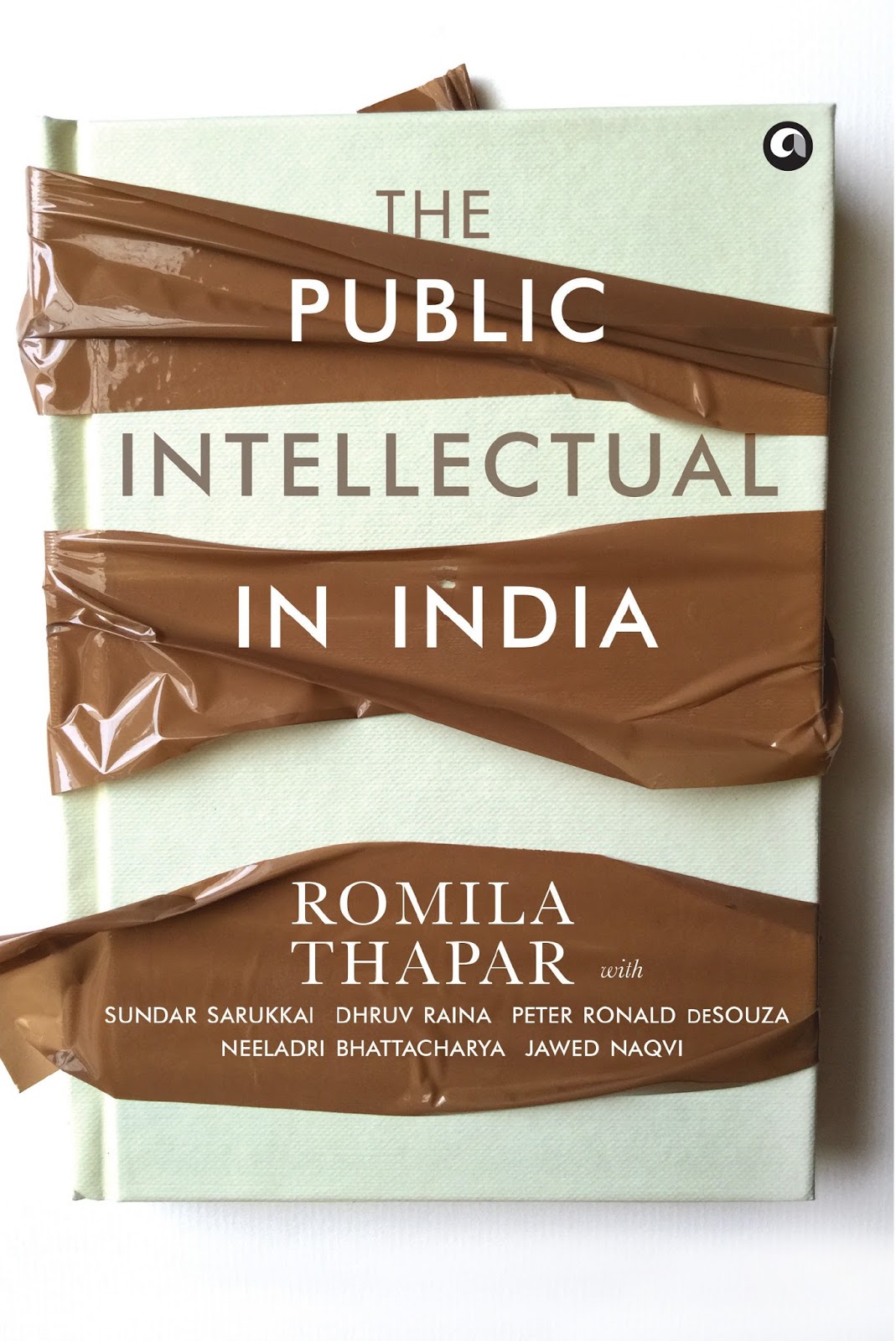
Noted historian Romila Thapar takes an autonomous stance on the growing inability to publicly debate liberal views in a politically-vitiated environment with an aim to resurrect the pubic intellectual who could think independently on behalf of the voiceless and the compromised. It is not as if public intellectuals are absent in our society, they never were, as human society has subconsciously nurtured them through the ages. From Socrates to Gandhi, to name a few, public intellectuals have always challenged entrenched notions and questioned identity politics with an unwritten premise to promote secular thoughts and actions. 

Thapar is convinced that in a successful democratic society, citizens should have equal social and economic rights irrespective of their religion, and even ideological positions. Drawing inferences from rich tapestry of history, philosophy, science, and politics enshrined in rich Indian tradition, Thapar presents secularism as a ‘process’ and not as a ‘position’, upon which a democratic-liberal nation gets built. Secularism is used here as a euphemism for plurality, a celebration of diversity in letter and its spirit.  

Based on a lecture the lead author delivered in 2014, The Public Intellectual in India shows us why it is important for objective, fearless and constructive voices to take charge to shape public discourses on issues affecting the society and the country at large. Five noted scholars offer their commentaries on the issue flagged by the lead author. Dissecting the identity of a public intellectual, philosopher Sundar Sarukkai argues that the real essence of a public intellectual is to create a ‘public’ in which his/her role becomes redundant and unnecessary. Social scientist Dhruv Raina stresses the need for fearless independence in the quest for progress.

The book is all about exploring reasons behind the rather erring silence of the public intellectual on the face of the so-called majoritarian politics. Why has the public intellectual exercised self-censorship in speaking up? Why is there a growing public culture against dissent? Why we only communicate with people with whom we agree? And, why are there angry mobs ready to lynch any divergent viewpoint? 

Exploring six vantage points from which public intellectuals must speak, political theorist Peter Desouza wonders if the likes of Shah Bano (who challenged the patriarchy within communities) and Anita Narre (who refused to return to her marital home because there was no toilet) were not the intellectuals who challenged the old order with their deeds. If public intellectual is perceived as one who speaks up against the present order, then there are growing numbers of people in everyday life who are unwilling to be guided by the past. Not only do we need to locate them but nurture them organically too! 

While agreeing that any attempt at being silenced must be resisted, historian Neeladri Bhattacharya wonders if the present picture is as dismal as the lead author may have painted. Isn’t silence a virtue, with an immense power of communicating more than words? Depending on how it is perceived, silence can turn out to be an active state of being. For Bhattacharya, the communal authoritarian forces are not as strong as they might seem. The presence of small dissenting voices exists in our society, and such voices do matter in history. Journalist Jawed Naqwi views the entire issue from the perspective of religious revivalism and the social identity of intellectuals. What has the public intellectual contributed to addressing the deep-seated social malaise? 

In all, there is no denying the fact that the society needs to host intelligent, civil conversations about controversial and often heated issues, with the aim of widening them both in scope and participation. The ultimate aim, argues Thapar, is not only to engage the public in thinking what they are going through but where they are heading. To this end, the role of dissenting voices, small or big, is to open individual’s understanding and individual’s choice of making an impact on decisions on their lives, and the lives of those to come after us. 

The book could not have come out at a better time. Whichever side of the ‘tolerance-intolerance’ debate one might be, one cannot be indifferent to the change that is being thrust upon us.  

The Public Intellectual in India
by Romila Thapar 
Aleph Books, New Delhi
Extent: 170, Price: Rs 499  

This review was first published in Deccan Herald on Feb 28, 2016.

Friday, January 15, 2016

Fish, Curry, and Dust

In exporting 35 per cent of the country’s ore, mining has used 8 per cent of the state’s richest land mass, and returned just 4 per cent to its exchequer by pocketing the rest.

When ethical and moral values are abandoned in favor of crass consumerism, immersion in total entertainment becomes the new normal. No wonder, little do those who throng the not-so-serene beaches to destress realize that the country’s pimple, as Nehru would call Goa, has been mercilessly squeezed of its natural assets. Consistent political patronage and persistent industrial greed has legitimized grossly reprehensible act of mining as the panacea to all ills. That this largely illegal act is making the land of ‘fish, curry and rice’ to eat dust seems a peripheral concern, if at all. 

At this time when most Goans, like the exuberant middle class elsewhere, have allowed themselves to be wooed by the argument that industrialization is a prerequisite for sustaining the growth appetite, Hartman De Souza comes out with an investigative narrative on the organized loot that has flattened green hills and sucked live aquifers dry in Goa. In exporting 35 per cent of the country’s ore, mining has used 8 per cent of the state’s richest land mass, and returned just 4 per cent to its exchequer by pocketing the rest. ‘Eat Dust’ is a shocking revelation on the appropriation of the state’s economy by private interests who have steady access to the gatekeepers: those who hold state office, and those who could influence it on demand. 

It is an environment thriller, loaded with extreme stories of treachery, gluttony and conspiracy. Ingrate politicians, conciliate bureaucrats and devious media form the familiar star cast, suitably supported by gullible landowners, petty businessmen and tongue-tied priests who create perfect playing ground for mining barons to carve out replica of Grand Canyon in the Western Ghats. Had it not been for the apex court putting a ban on mining in 2012, these actors would have stripped the state of its remaining estimated 1.3 billion tons of ore worth over US$ 6 billion. 

Hartman’s chronicle is a factual blow-by-blow account of what actually happened on the ground – tracing the political route to the story from the time Goa’s first chief minister, Dayanand Bandodkar, was hand-picked to lead by mining companies, because they recognized both his acumen and his sympathy for their own greater cause. Since then the baton has remained in safe hands, proactive political collusion has perpetuated greed. 

Not to be missed in this socio-anthropological and ecological history of Goa is the story of protracted opposition by handful men and women, who have taken the battle to the heavily guarded mines across the state. Despite intimidation by goons of the mining mafia with support from the local police, the mother-daughter duo of Dora and Cheryl had chained themselves when the barrier to the Dinar Tarcar’s mine was still down, to record their genuine anger against unscrupulous mining close to their habitation. Local opposition has only continued to grow, providing perfect backdrop to the activists pursuing legal proceedings against illegal mines.    

Despite standing for, and contributing to opposition against illegal mining, the author laments the lack of mass upsurge against mining in Goa. Will people in Panjim understand how bad mining is only when they find red dust flowing out of their taps? It seems everyone has been poisoned by a uniform coat of dust, tossed up by the trucks plying ore from the mine to the harbor, that there is nothing that can stop the rot from spreading. On top of it, the mining mafia has carefully quashed any annoyance with promises that are partially fulfilled at any given time. 

More than just hit-and-run kind of reporting ‘Eat Dust’ is courageous writing aimed at bringing information, details of which have either been hidden from the public or nobody had the courage to discover it in the first place.  Written with painstaking details, Hartman has sunk his teeth deep into the story without allowing him to be bullied. What comes out is a narrative that smells of a strange mix of passion and anguish, uncovering the rot that plagues the mining sector – not only in Goa but in the rest of the country as well. 

‘Eat Dust’ should be essential reading for all those who may have even an iota of interest in pretty trees, sparkling springs, and majestic tigers. 

Eat Dust: Mining & Greed in Goa
by Hartman De Souza
Harper Litmus, New Delhi
Extent: 277, Price: Rs 350 

This review was first published in The Hindustan Times on Jan 9, 2016. 

Sunday, January 3, 2016

One molecule, many formulations

Of all known liquids, water is probably the most studied and least understood.

The Water Book
Hachette, New Delhi
Extent: 376. Price: Rs 499
                  
How would you fathom a contrasting situation wherein one guy fights crises of water supply at home while a distant friend goes shopping for a fishing gear to exploit the small stream flowing through his coffee farm? Enviable undoubtedly, what is ‘fish out of water’ for one is ‘catch a fish’ opportunity for the other. That is what water does under differing situations, perhaps a grim reminder on its undisputed value for human existence, and more importantly for being human. We seem to value the universal liquid when it is in short supply, but do we understand it well?

‘Of all known liquids,’ wrote the great water chemist Felix Franks, ‘water is probably the most studied and least understood.” Taking cue, Alok Jha has set out to write a biography on this wonder molecule, and has come out with an exhaustive treatise on the subject. Of all mysterious properties of water, the dielectric constant sets it apart from other naturally occurring materials. At an incredible value of 80, its large dielectric constant breaks affinity between other molecules with ionic bonds and earns itself the title of a universal solvent. No wonder, whenever one thinks of a liquid one is thinking of water with a small amount of other things dissolved or suspended within it. Could this be one of the reasons for its omnipresence on this planet?

Water has invented humans, and indeed sustains all other life forms on the earth. Paradoxically, however, a liquid that is part of life is also one of fear and death. Some of the most dreaded creatures live under water, carrying on eternal war amidst them by preying on each other. There is nothing softer and weaker than water, and yet nothing as hard and strong too. Jha journeys through the hydrosphere, biosphere, and cryosphere to capture the nature and properties of the second most abundant molecule in the universe.

Putting the works of several philosophers, chemists and hydrologists into perspective, the author marvels at the way water molecule acts like hawala system of informal cash transaction in transferring energy at impossible speed. Just as hawala system works on trust and word of mouth, so does networks of hydrogen-bonded water molecules in carrying the charge of protons from one part of a cell to another. The Water Book captures all this and much more, but is a trifle too long. While it is a useful addition to water literature, it could be worthy as a textbook.

The Last Drop
Mike Gonzalez & Marianella Yanes
Pluto Press, UK
Extent: 202. Price: Rs 1,357
The Last Drop offers a study in contrast. Focusing on the trade and politics of water, the professor-journalist duo of Mike Gonzalez and Marianella Yanes lament the growing insanity of identifying with bottled water as a social drink – consumed by elegant people in elegant bars. It is no surprise therefore that some nine billion bottles of water are sold annually across the world. The massive expansion of the private water industry, including bottle water industry, is an outcome of neoliberalism’s commitment to the privatization of all public services and public goods.

Outwardly it may seem to be the only way out to address the issue of access and quality, the reality is that big corporations with turnover exceeding US$40 billion annually have contributed literally nothing to the resolution of the water problem. This isn’t surprising when one learns that 34 per cent of water and sewerage privatizations have failed across the world, with as many as 180 cities having re-municipalized their water operations.

Citing real case stories of predatory privatization, from Mexico to Kerala and from Loas to Bolivia, the authors contend that capitalism is anything but blind to ecology. It transforms nature into commodities, homogenizing it into products which can be traded for profit. Calling for a new world water order, the book seeks collective engagement of all small movements in big picture change in favor of water peace, as opposed to the widely publicized prediction of possible ‘water wars’. Simply put, the struggle over water is not only about water, it is also about land and more extensively about democracy and rights.

Examining corporate control over water and the ensuing struggle for water resources worldwide, Gonzalez and Yanes join the activists in saving water from overt and covert privatization. The Last Drop is a grim reminder and a wake-up call to liberate water from the predominant notion that ‘whoever controls water controls society’. Exposing the complex arguments surrounding water, the book makes technical and scientific case for pushing back the market fundamentalism in favor of equity and social justice. All this for a single drop of water.

This review has been published in Current Science dated March 10, 2016.

Sunday, December 20, 2015

Tale of experience

Systems and rules are for the fools, and it needs power of imagination to fool the system.

Piyush Pandey’s writing is like an onion with endless layers that seamlessly unravel clues in simplicity of everyday living. Such is the beauty of his writing that it takes the reader along, making he or she traverse the distance as if it has been one’s own. 

The only difference being that we allow memories of encounters with the likes of cobblers and carpenters to fade away. He, instead, retrieves them at short notice to seek imaginative insights and fresh perspectives. He does it with ease and ability because he hasn’t allowed the ‘child’ in him to die, which has made him an extraordinary ‘man’, albeit an ad-man. 

Pandeymonium is loaded with intriguing insights and creative ideas, offering subtle but profound reflections on how indeed professionals must guide their lives. Aren’t a vast majority trapped in preconceived notions and unknown fears to break new ground, lamenting instead that the system sucks their creative energies? Don’t be scared of systems and processes, echoes Piyush, there are ways to fool them. This reminds me of veteran journalist and distinguished editor Pran Chopra who often used to say “Follow the rules to break the rules”. Systems and rules are for the fools, and it needs power of imagination to fool the system.

Primarily written for advertising professionals, as the title page suggests, the straight-from-the-heart narrative of experiences can capture the attention of any avid reader. Quick to read and easy to grasp, it is a book about letting big ideas fly on the wings of imagination. It is a book on generating and shaping convincing ideas. It is a book about building relationships with those with whom you have nothing in common. Finally, it is a book about going underwater and marveling at the iceberg that you don’t get to see otherwise.

Each of his award-winning creations has an interesting story lurking behind. Be it the series of Fevicol commercials or numerous Vodafone Zoozoos, Piyush has applied his cricketing skills to step out of the crease to score the maximum. For stepping out, one needs to be confident about the idea. Quite often, a lot of professionals are insecure about their idea. The less you share the idea, the less the possibility for a good idea to become great. The caveat, however, is to use those sounding boards with whom you can share and confide. The genesis of a big work comprises a big heart, big vision, big belief and big faith. 

Pandeymonium brings together the power of ideas and perceptions to win clients and the audiences. Having demonstrated it through his work, the author wonders why should anyone feel deprived when one’s own learning has given some important weapons — the power of imagination, the power of your pen, and the power to communicate effectively. Important as it is, to be sure about one’s idea is not to worry about accusations and suspicions. 

Born into a family with eight siblings, Piyush spent his formative years in Jaipur before moving out to do his master’s at St Stephen’s College, Delhi. A passionate cricketer, having played in the Ranji Trophy, he integrated all his experiences of life in carving out a prestigious position in the ad world. Sporting a prominent Walrus mustache, his weary smile on the cover page reflects a face of creative conviction and satisfaction.

Piyush’s autobiographical journey is all about small experiences, interactions and encounters in life. Each experience is worth its weight in gold, provided one knows how to draw insights from it. The take home message from the book is that we each have a story to tell, but the story can only be great if the story is humane in nature and can touch hearts.  

Pandeymonium
by Piyush Pandey
Penguin, New Delhi
Extent 244, Price Rs 799

This review was first published in Deccan Herald on December 20, 2015.

Friday, November 13, 2015

Beyond the statistical fog

GDP may have worked despite its fallibility till now, but it is unlikely to serve henceforth as the economy gets driven more by innovation, services, and intangible goods.

It is a ‘made up entity’ that has become the rallying point for governments to reflect their economic prowess. Usually expressed in single digit, it needs sustained nurturing, lest governments can be toppled and fresh elections enforced. Since it was formally coined in the 1940s, GDP has continued to engage best of economic brains to develop a standard measure of a country’s economy. Yet, this familiar piece of jargon means little to most people because the health of the country’s economy often has little bearing on peoples’ lives. 

No wonder, it can decide elections but can't make people happy and it can make news but can't erase income inequality. GDP is a powerful teaser that has thus far remained artificial, abstract and complex. Providing a much-needed historical perspective on this elusive bit of static, Harvard Economist Diane Coyle argues that GDP has remained a piece of ‘static’ in the hands of the ‘state’, and must not be confused with social welfare. At best, it creates a self deceptive image of contributing to overall welfare. In reality, much of the welfare activities, for lack of mathematical expression, do not get counted in it. Ms. Coyle has been grateful to Cabbage, her dog, who may not have contributed to GDP but greatly to her welfare! 

Since the making of physical commodities count toward national income, green forests holds zero value whereas chopped trees add to the GDP. Environmentalists therefore believe that GDP leads to an overemphasis on growth at the expense of the planet, obscuring the wrongs of the capitalist market economy. Such assertion is not without reason, as spending on pollution-abatement equipment adds to GDP but the negative effect of pollution doesn’t pull GDP down. GDP may have worked despite its fallibility till now, but it is unlikely to serve its purpose henceforth as the economy gets driven more by innovation, services, and intangible goods.

While the author remains ‘affectionate’ towards GDP, as the title suggests, she nonetheless argues that it is flawed and search for its alternative has been ongoing. However, alternatives ranging from the Measure of Economic Welfare (MEW) to the Better Life Index (BLI) haven’t evoked enough confidence in replacing the ubiquitous piece of static. Welfare has been the leitmotif of the proposed change, but counting intangibles has remained a challenge. Even more challenging is to count value of zero-priced goods like online music, search engines, crowd sourcing, and so on. These do contribute to productivity, and even loss of jobs, in many ways without being captured in GDP statistics.  

Wading through the murky world of number crunching, Coyle presents a fascinating biography of GDP which, despite its inherent fallacies, continues to remain the greatest innovation of the 20th century. Yet, as the Greek tragedy unfolds, the so-called irrational exuberance has led to self-delusions and inadequacies of regulatory bodies, leading to financial crises. Since market-led global capitalism is sweeping the whole world, GDP need to be sanitized from overt influence of market manipulation. The financial crisis has pressed the urgency button to rethink economic valuation of products’ quality, zero-priced goods and services’ efficiency. 

As the economy is driven more by innovation and services, accounting activities operating outside the tax net and production matrix has become imperative. With boundary between growth and progress, and between leisure and work going through significant transformation, GDP will lose relevance if it doesn’t translate into increased happiness. For GDP to remain relevant it must resolve the well-known paradox of a widower who marries his house maid. His marriage leads to reducing GDP as he longer pays her the wages, but should the happiness both gain be left unaccounted for? In this engaging and witty book, Coyle leaves the reader with the challenging optimism of life beyond the prevailing statistical fog. 

GDP: A Brief but Affectionate History
by Diane Coyle
Princeton University Press, UK
Extent: 160, Price: US$19.95  

This review was published in The Hindustan Times dated Nov 21, 2015.           

Thursday, October 29, 2015

Intolerance, a new social order?

What you read, see, and eat (and even think) is under gaze of self-styled moral custodians of social and cultural behaviour.

If freedom of expression is what democratic societies aspire for, then the use of ink to smear faces and the might of pen to spew hate can only reflect violent behaviour. Though uncalled for, such incidents have become more of a norm than exception in recent times. Triggered by ideological underpinnings, intolerance is threatening to emerge as a new social order. Make one mistake or crack a joke on the social media, and a merciless gang is likely to ruin your life.

What you read, what you see, and what you eat is under gaze from self-styled moral custodians of social and cultural behaviour. Why is it that the ‘otherness’ of the others has become so disturbing that the disruptive forces have gone on an overdrive to shame them into submission? How is it that there has been sudden spurt in public shaming as a new social vocation, that is not only sweeping the social media but its coercive nature is increasing in speed and influence? 

From authors to anchors, from academicians to activists, discontent is brewing among public figures to stay off social media, especially Twitter, to avoid invective.  Since social media offers anonymity, there has been general escalation in such hostilities. Researchers have found that anonymity not only shields ‘abusers’ but helps people aligned to a particular ideology to commit acts of violence that they would never dream of committing individually.

The act of shaming others, as this is understood, has been used in the past to correct peoples’ behaviour albeit in a transparent manner without being anonymous. Never before it has been used the way it is currently being practiced; it has indeed gone global in recent years. Public shaming has become a potent tool, called ad hominem attack, wherein unknown attackers take on the criticiser because they are unable to defend a criticism against their ideology.

Is it that the internet has given power to those who otherwise would be powerless or has this tool of social networking gone into those hands whose sinister aim is to manufacture consent? Need it be said that most of us are vulnerable to shaming, chronically ashamed of how we look, or how we feel, or what they said, or what they did. For Jon Ronson, the author of ‘So, You Have Been Publicly Shamed’, shaming has only been working because the shamee is playing a part in being ashamed.

Following on many high-profile recipients of public shaming in recent years, Jon has drawn some interesting observations that reflect upon our current predicament with what is normal and what is not. 

Are we not defining the boundaries of normality by tearing apart those who are out of it? It would seem so as we are unknowingly creating a world where the smartest way to survive is to be bland. One will hesitate to accept such a world where making the others look stupid abounds.

The trouble is that not what all ‘others’ say or feel is stupid all the times. Take the case of Ravish Kumar, host of a daily chat show on a private television channel who has been at the receiving end of hate mongers on the social media sites for his differing opinion on recent political developments. While the average male does receive his share of virulent remarks, the choicest threats are often reserved for women. There are many people, both men and women, around who are being forcibly shamed into submission.

The question that begs an answer is: has the social media created a new opportunity for locating other persons’ flaws (even if there is none) or has it been a psychic trait that is now fully blown? Since people often wear emotions on their sleeves, public shaming can have deleterious effect on many of them. James Gilligen, who served on many UN high-powered committees on the causes of violence, concludes that shaming can lead to deadening of feelings which can provoke serious act of violence in many cases.

Curiously, it is easy to declare other people insane than to admit one’s own insanity. For good or bad reasons, there are cases where people have not only lost their jobs for virulent campaign on the social media but many had to hide themselves from public gaze for several months. Internet is a tricky beast and social media a moving target. What it does though is make an iota of lie into a mound of truth. Since no one checks on the authenticity of what gets posted, the same goes viral in seconds.

In a culture where we feel constantly under surveillance, people are becoming afraid of being themselves. This is undoubtedly a disturbing trend. While hosts of de-shaming services are now available that ensure that much of the malicious content doesn’t appear in internet searches, the challenge is to address this deeper psychological malice from both sociological and political perspectives. 

Unless act of public shaming is nipped, humiliation can have far-reaching impact on individuals as well as the society.

So, You've Been Publicly Shamed
by Jon Ronson
Picador, UK
Extent: 278 pages, Price: Rs 599

These reflections were first published in Deccan Herald on October, 29, 2015.

Sunday, October 18, 2015

The forgotten princess

Avoiding self-pity, the forgotten princess emerges as a woman of courage and conviction as she conducts herself independently for fourteen long years of separation from her husband. 

One wonders why Valmiki devoted only four lines in Ramayana on Urmila, Sita’s sister and wife to Rama’s devoted brother Lakshman, who was asked to stay back while her husband escorted his brother and her sister to the forest for fourteen long years? Legend has it that despite being ready to accompany him, Urmila was advised against it as her husband would have little time for her, other than serving the couple in the forest. She was found missing from the rest of the epic, apparently in deep sleep, only to be woken up after fourteen years to witness Rama’s coronation. 

Unseen and unheard, Urmila is considered one of the forgotten heroines of Indian literature by Rabindranath Tagore. Valmiki may have considered Urmila as a minor character, but in his poetic version of the epic, noted poet Mythili Sharan Gupta has made Urmila the central character in Saket. Even in Telugu literary play Urmila Devi Nidra, Urmila has been placed on a higher pedestal than Sita as an ‘ideal wife’. Intriguing, however, is how must have Urmila negotiated the situation when she was neglected by those two whom she loved the most, husband Lakshman and sister Sita?  

In her absorbing narrative recreated out of mythology and folklore, Kavita Kane narrates the story according to Urmila in Sita’s Sister. Despite being left out and let down, Urmila did accost Lakshman on his unilateral decision, wondering why he would need to go when he wasn’t exiled. Even while accepting the inevitable; Urmila does not shy away from seeking her legitimate rights knowing well that her sacrifice will help Lakshman earn nobility by serving his brother. Yet, she avoids wallowing in self-pity and emerges as a woman of courage and conviction as she conducts herself independently over the following fourteen years. 

Urmila may have been wasted away in sleep, as folklore has it, for fourteen long years, but the author fleshes out a hitherto unknown character of Urmila by using the metaphor of ‘sleep’ as an interpretation for ‘self-realization’, dismissing the symbolic representation of sleep for a married woman sans her husband is supposed to sink into. Instead, she excels herself as a devoted daughter-in-law, an astute administrator, a talented painter and a great scholar.   

Sharing space with respected scholars like Vashishta, Markandeya and Jaabali at the prestigious brahmanyagna, Urmila questions the rationality of religion and its influence on the nature of religious truth rather than seeking the divinity in religion. Waking out of her proverbial sleep, Urmila discovers herself not just the woman of passion as her name so defined but one whose heart and mind had come together in intellectual and spiritual enlightenment. Could she have discovered the scholar in herself without experiencing pain, separation and detachment? In fact, her separation from Lakshman became her meditation, her spiritual birth and her salvation.  

Sita’s Sister discovers many facets of Urmila, which never got a respect of place in the grand narrative. In her fresh interpretation of the epic, the author delves into the life of a woman who is forced to put her life on hold. Like a tower of strength, Urmila not only tended her feminine duties towards women in the palace but lent administrative hand in the affairs of the kingdom in the absence of Bharat. Her role gets acknowledged by members of the palace as the one ‘who made it the home one wants to return every single day’. Urmila performed the dharma of a wife, a daughter-in-law but never got an answer to her nagging question ‘what is the dharma of the husband to her wife’? 

By giving a fictional spin to the grand old story, the author peeps into the life of one of the prominent unsung characters and offers insights into her mind and her actions. Urmila offers contrasting images of parents’ home and the one she gets married into. While she enjoyed freedom of thought and action at her parents’ place, the royal palace in contrast was just to its people but cruelest to its own family members. Yet, she rarely resented her existence in the palace. Dissension to her was part of seeking light at the end of the tunnel. 

Valmiki had reasons not to delve deeper into the psyche of Urmila who, in her own way, helped everyone in the royal palace to smile. ‘Learn to smile, that small curve can straighten lot of things’. Sita’s Sister is an immensely readable and absorbing story that lets the reader get to see other side of the story, relevant to our times. 

Sita’s Sister 
by Kavita Kane 
Rupa, New Delhi. 
Extent: 311; Price. Rs 295

This review was first published in Speaking Tree (The Times of India), on Oct 18, 2015.