It is a sheer enigma that the feel-good ideology of pluralism has outlived four decades of populist viewing.
Nearly 40 years after it had hit the screens, three authors have reconstructed the ‘illogic’ of Manmohan Desai’s blockbuster film Amar Akbar Anthony frame by frame. For William Elison, Christian Lee Novetzke, and Andy Rotman, the production is more than a fantasy film in the masala genre as it affirms a moral universe in which good triumphs over evil, villainy is vanquished, patriotism is enshrined, and the laws of family duty are established. What comes out is a layered interpretation of the film’s deeper symbolism, relevant to these times when secularism is not only a bad word but also under threat of misinterpretation.
It may have been a crazy lost-and-found entertainer, but its leading characters — Amar, Akbar, and Anthony are Hindu, Muslim, and Christian, as well as policeman, qawwal, and dada respectively — reflect the cultural anxieties of the state, the nation, and civil society. It has been viewed differently by different people, though. While it carries a subtle political message for filmmaker Shyam Benegal, it has been a kind of ‘illogic’ with a strong emotional content for actress Shabana Azmi. It was dumped by critics who found it loaded with implausible situations and unrealistic characters, and yet it continues to be seen as a film about national integration. Its enduring appeal has cemented its place among Bollywood classics.
Desai had a method in his illogic and justified his oblique method of delivering positive messages, arguing that nothing less than a palatable, sugar-coated pill would have delivered the message about cultural and communal harmony. The film’s three eponymous brothers assert their respective identities at numerous points, but find unity in their diversity in the end, as one brother quips, ‘we are three in one’. Could it be possible in reality? Even though the film presents the possibility of a ‘reality’, it offers differing and competing perspectives. It emphasises the presence of multiple realities. Given the complex matrix of sub-plots feeding into the story’s melodrama, this subsumes the central theme of the film. While many viewers find the lack of a single cohesive message disappointing, the film remains a celebration of competing and contradicting perspectives. After all, one story is never the full story.
In drawing multiple perspectives from religion, history, literature and popular culture, the authors search for the real hero amongst the dominant characters of the film. Could it be Amar, scion of an implicitly Hindu-dominated state, or Akbar, the romantic Muslim as model minority, or Anthony, the good-hearted Christian hooch peddler? Could it not be the quintessential long-suffering mother, played by Nirupa Roy, who as ‘Bharati’ remains blind through the better part of the film? It is the restoration of her sight through divine intervention that gives the three leading characters a sense of purpose with respect to their individual identities, within the copious bosom of a Mother India (the name of the mother directly invokes the name of the country). Only by reuniting with their mother do the boys embrace brotherhood. With such an imaginative leap, the narrative creates a mesmerizing
impact on its viewers.
It is a sheer enigma that the feel-good ideology of pluralism has outlived four decades of populist viewing.
Described as the ultimate formula film, it can be easily read as a multivalent allegory encompassing many tragic elements of human existence. Packed within its comic overtones are tragic interludes, ranging from the perceived backwardness of the masses to the irresponsiveness of a political class. However, it must be to the credit of the film-maker that despite the story’s dealing in slum neighborhoods
, lost youth, and deprived people, the audience lapped it up as an escape from the drudgery of reality. It is through such an unwritten agreement with the viewers that Desai could salvage the dream of creating a cinematic illusion of secularism.
Without doubt, the book Amar Akbar Anthony is an interdisciplinary gift by three fans to the innumerable fans of an all-time classic. In analyzing
the enduring appeal of a sheer entertainer, Elison, Novetzke and Rotman have pooled their individual scholarships in the fields of religion, anthropology and international studies, and come up with a brilliant, multi-layered reading of the film. Like the oft-told fable of the blind men and the elephant, they have applied selective blinkers to construct the elephant. The authors caution the reader to finish the book with the feeling that the elephant is also a tree. If you think that’s impossible, well, that is what the film is all about.
The final sequence, with the musical number conveys the crux of the story. The ‘Anhoni Ko Honi Kar De’ — to make the impossible possible — is a celebration of co-operation and unity in diversity. It reminds the viewer to consider making the impossible possible. It is detailing such as this that makes the book immensely entertaining.
Amar Akbar Anthony: Bollywood, Brotherhood, and the Nation
by William Elison, Christian Lee Novetzke & Andy Rotman
Harvard University Press, UK
Extent: 334, Price: Rs 995
This review was first published in the Hindu BusinessLine weekend supplement BLInk dated March 19, 2016.
There is no denying the fact that the society needs to host intelligent, civil conversations about controversial and often heated issues, with the aim of widening them both in scope and participation.
In an era when noise is favored over discussions and shallow comments over deep conversations, consent is being engineered on the foundation of subjectivity. Dissent, the fundamental act of faith in democracy, has become a bad word. As things stand today, not only are conclusions drawn in a jiffy, opinions quashed in limited characters are posted for public consumption. On top, space for those who could influence public opinion has shrunk, and scope for engaging people in dialogue on the kind of society they wish to construct has narrowed.
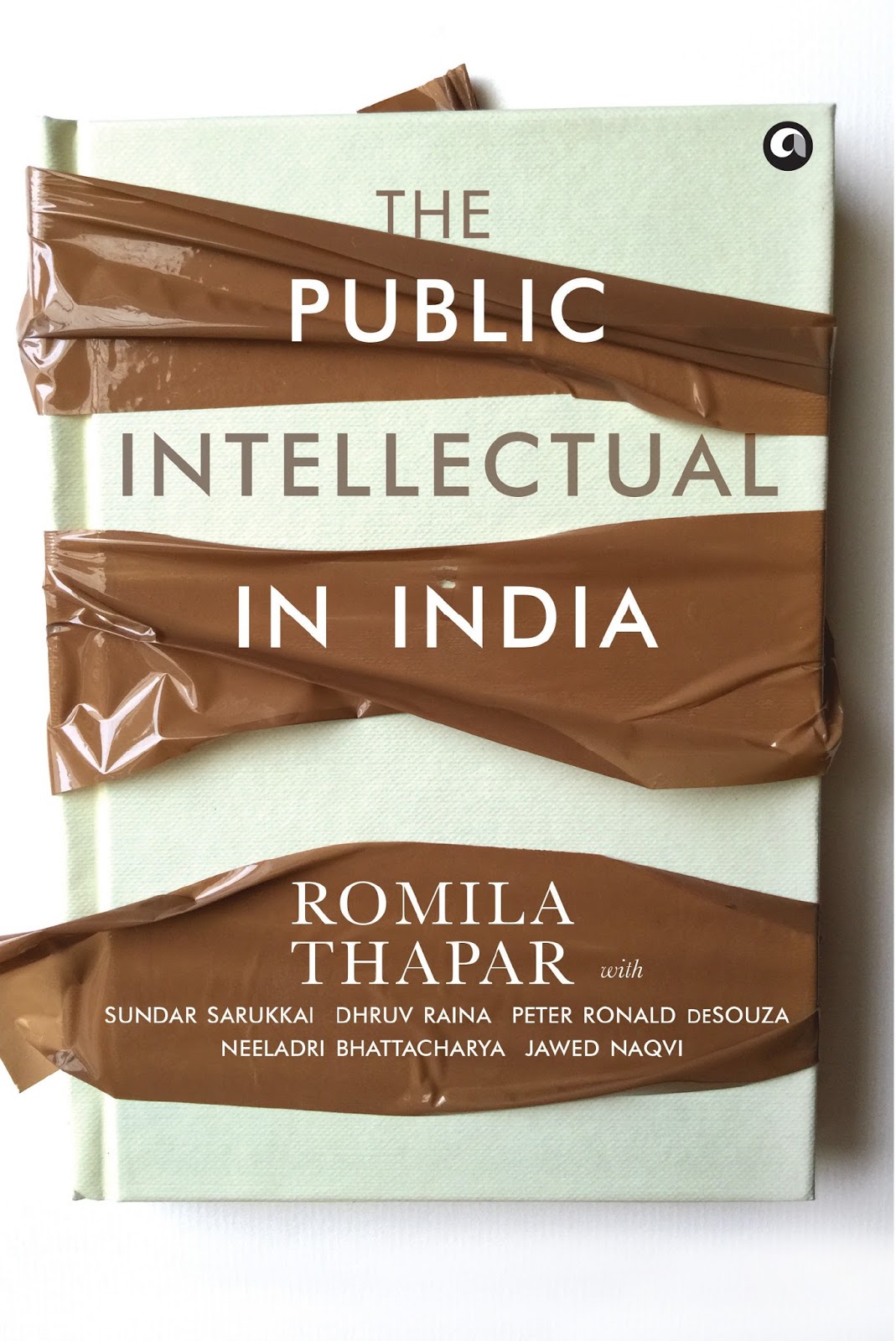
Noted historian Romila Thapar takes an autonomous stance on the growing inability to publicly debate liberal views in a politically-vitiated environment with an aim to resurrect the pubic intellectual who could think independently on behalf of the voiceless and the compromised. It is not as if public intellectuals are absent in our society, they never were, as human society has subconsciously nurtured them through the ages. From Socrates to Gandhi, to name a few, public intellectuals have always challenged entrenched notions and questioned identity politics with an unwritten premise to promote secular thoughts and actions.
Thapar is convinced that in a successful democratic society, citizens should have equal social and economic rights irrespective of their religion, and even ideological positions. Drawing inferences from rich tapestry of history, philosophy, science, and politics enshrined in rich Indian tradition, Thapar presents secularism as a ‘process’ and not as a ‘position’, upon which a democratic-liberal nation gets built. Secularism is used here as a euphemism for plurality, a celebration of diversity in letter and its spirit.
Based on a lecture the lead author delivered in 2014, The Public Intellectual in India shows us why it is important for objective, fearless and constructive voices to take charge to shape public discourses on issues affecting the society and the country at large. Five noted scholars offer their commentaries on the issue flagged by the lead author. Dissecting the identity of a public intellectual, philosopher Sundar Sarukkai argues that the real essence of a public intellectual is to create a ‘public’ in which his/her role becomes redundant and unnecessary. Social scientist Dhruv Raina stresses the need for fearless independence in the quest for progress.
The book is all about exploring reasons behind the rather erring silence of the public intellectual on the face of the so-called majoritarian politics. Why has the public intellectual exercised self-censorship in speaking up? Why is there a growing public culture against dissent? Why we only communicate with people with whom we agree? And, why are there angry mobs ready to lynch any divergent viewpoint?
Exploring six vantage points from which public intellectuals must speak, political theorist Peter Desouza wonders if the likes of Shah Bano (who challenged the patriarchy within communities) and Anita Narre (who refused to return to her marital home because there was no toilet) were not the intellectuals who challenged the old order with their deeds. If public intellectual is perceived as one who speaks up against the present order, then there are growing numbers of people in everyday life who are unwilling to be guided by the past. Not only do we need to locate them but nurture them organically too!
While agreeing that any attempt at being silenced must be resisted, historian Neeladri Bhattacharya wonders if the present picture is as dismal as the lead author may have painted. Isn’t silence a virtue, with an immense power of communicating more than words? Depending on how it is perceived, silence can turn out to be an active state of being. For Bhattacharya, the communal authoritarian forces are not as strong as they might seem. The presence of small dissenting voices exists in our society, and such voices do matter in history. Journalist Jawed Naqwi views the entire issue from the perspective of religious revivalism and the social identity of intellectuals. What has the public intellectual contributed to addressing the deep-seated social malaise?
In all, there is no denying the fact that the society needs to host intelligent, civil conversations about controversial and often heated issues, with the aim of widening them both in scope and participation. The ultimate aim, argues Thapar, is not only to engage the public in thinking what they are going through but where they are heading. To this end, the role of dissenting voices, small or big, is to open individual’s understanding and individual’s choice of making an impact on decisions on their lives, and the lives of those to come after us.
The book could not have come out at a better time. Whichever side of the ‘tolerance-intolerance’ debate one might be, one cannot be indifferent to the change that is being thrust upon us.
The Public Intellectual in India
by Romila Thapar
Aleph Books, New Delhi
Extent: 170, Price: Rs 499
This review was first published in Deccan Herald on Feb 28, 2016.