Showing posts with label Intolerance. Show all posts

Sunday, February 28, 2016

Time to introspect

There is no denying the fact that the society needs to host intelligent, civil conversations about controversial and often heated issues, with the aim of widening them both in scope and participation.

In an era when noise is favored over discussions and shallow comments over deep conversations, consent is being engineered on the foundation of subjectivity. Dissent, the fundamental act of faith in democracy, has become a bad word. As things stand today, not only are conclusions drawn in a jiffy, opinions quashed in limited characters are posted for public consumption. On top, space for those who could influence public opinion has shrunk, and scope for engaging people in dialogue on the kind of society they wish to construct has narrowed. 

Noted historian Romila Thapar takes an autonomous stance on the growing inability to publicly debate liberal views in a politically-vitiated environment with an aim to resurrect the pubic intellectual who could think independently on behalf of the voiceless and the compromised. It is not as if public intellectuals are absent in our society, they never were, as human society has subconsciously nurtured them through the ages. From Socrates to Gandhi, to name a few, public intellectuals have always challenged entrenched notions and questioned identity politics with an unwritten premise to promote secular thoughts and actions. 

Thapar is convinced that in a successful democratic society, citizens should have equal social and economic rights irrespective of their religion, and even ideological positions. Drawing inferences from rich tapestry of history, philosophy, science, and politics enshrined in rich Indian tradition, Thapar presents secularism as a ‘process’ and not as a ‘position’, upon which a democratic-liberal nation gets built. Secularism is used here as a euphemism for plurality, a celebration of diversity in letter and its spirit.  

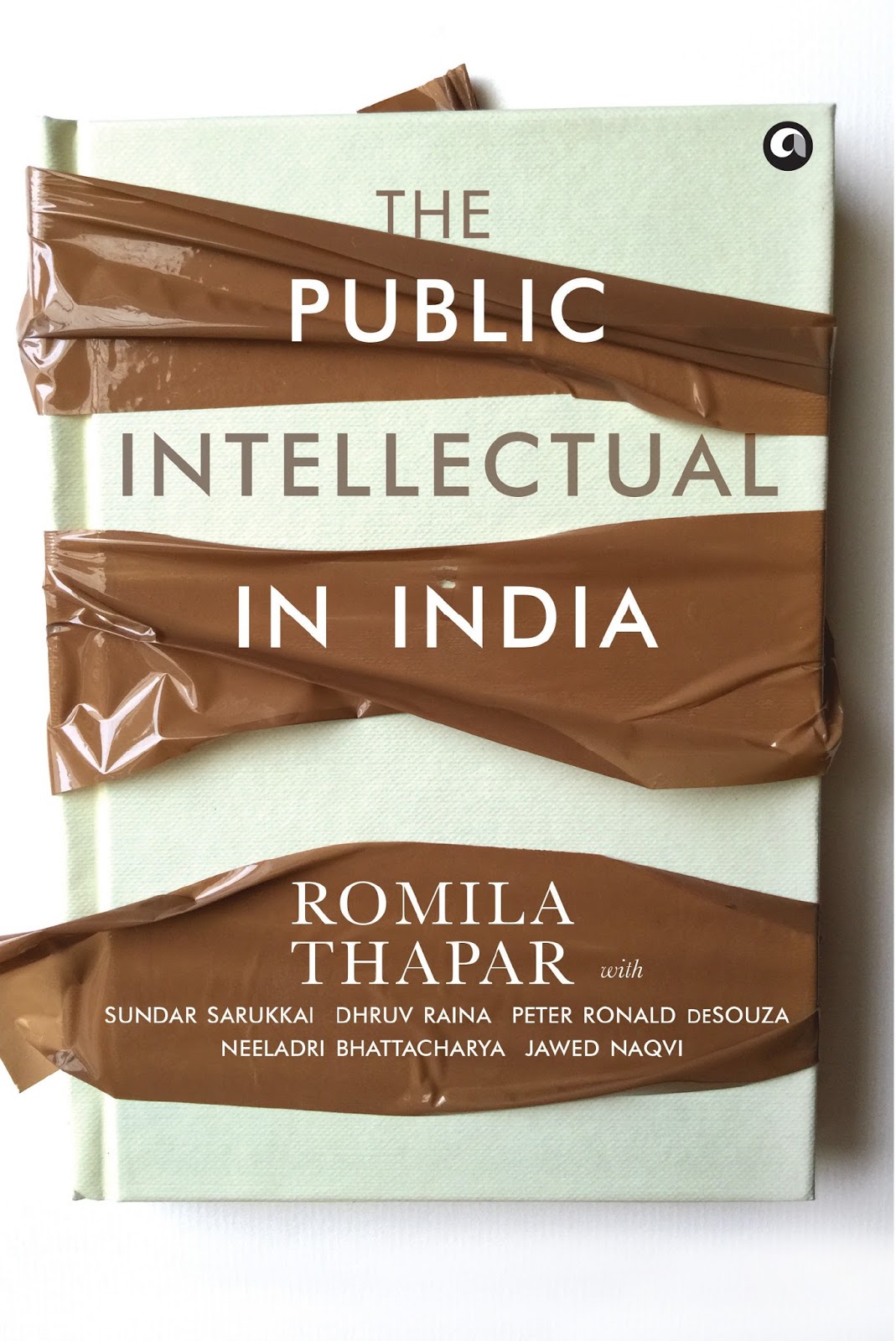
Based on a lecture the lead author delivered in 2014, The Public Intellectual in India shows us why it is important for objective, fearless and constructive voices to take charge to shape public discourses on issues affecting the society and the country at large. Five noted scholars offer their commentaries on the issue flagged by the lead author. Dissecting the identity of a public intellectual, philosopher Sundar Sarukkai argues that the real essence of a public intellectual is to create a ‘public’ in which his/her role becomes redundant and unnecessary. Social scientist Dhruv Raina stresses the need for fearless independence in the quest for progress.

The book is all about exploring reasons behind the rather erring silence of the public intellectual on the face of the so-called majoritarian politics. Why has the public intellectual exercised self-censorship in speaking up? Why is there a growing public culture against dissent? Why we only communicate with people with whom we agree? And, why are there angry mobs ready to lynch any divergent viewpoint? 

Exploring six vantage points from which public intellectuals must speak, political theorist Peter Desouza wonders if the likes of Shah Bano (who challenged the patriarchy within communities) and Anita Narre (who refused to return to her marital home because there was no toilet) were not the intellectuals who challenged the old order with their deeds. If public intellectual is perceived as one who speaks up against the present order, then there are growing numbers of people in everyday life who are unwilling to be guided by the past. Not only do we need to locate them but nurture them organically too! 

While agreeing that any attempt at being silenced must be resisted, historian Neeladri Bhattacharya wonders if the present picture is as dismal as the lead author may have painted. Isn’t silence a virtue, with an immense power of communicating more than words? Depending on how it is perceived, silence can turn out to be an active state of being. For Bhattacharya, the communal authoritarian forces are not as strong as they might seem. The presence of small dissenting voices exists in our society, and such voices do matter in history. Journalist Jawed Naqwi views the entire issue from the perspective of religious revivalism and the social identity of intellectuals. What has the public intellectual contributed to addressing the deep-seated social malaise? 

In all, there is no denying the fact that the society needs to host intelligent, civil conversations about controversial and often heated issues, with the aim of widening them both in scope and participation. The ultimate aim, argues Thapar, is not only to engage the public in thinking what they are going through but where they are heading. To this end, the role of dissenting voices, small or big, is to open individual’s understanding and individual’s choice of making an impact on decisions on their lives, and the lives of those to come after us. 

The book could not have come out at a better time. Whichever side of the ‘tolerance-intolerance’ debate one might be, one cannot be indifferent to the change that is being thrust upon us.  

The Public Intellectual in India
by Romila Thapar 
Aleph Books, New Delhi
Extent: 170, Price: Rs 499  

This review was first published in Deccan Herald on Feb 28, 2016.

Thursday, October 29, 2015

Intolerance, a new social order?

What you read, see, and eat (and even think) is under gaze of self-styled moral custodians of social and cultural behaviour.

If freedom of expression is what democratic societies aspire for, then the use of ink to smear faces and the might of pen to spew hate can only reflect violent behaviour. Though uncalled for, such incidents have become more of a norm than exception in recent times. Triggered by ideological underpinnings, intolerance is threatening to emerge as a new social order. Make one mistake or crack a joke on the social media, and a merciless gang is likely to ruin your life.

What you read, what you see, and what you eat is under gaze from self-styled moral custodians of social and cultural behaviour. Why is it that the ‘otherness’ of the others has become so disturbing that the disruptive forces have gone on an overdrive to shame them into submission? How is it that there has been sudden spurt in public shaming as a new social vocation, that is not only sweeping the social media but its coercive nature is increasing in speed and influence? 

From authors to anchors, from academicians to activists, discontent is brewing among public figures to stay off social media, especially Twitter, to avoid invective.  Since social media offers anonymity, there has been general escalation in such hostilities. Researchers have found that anonymity not only shields ‘abusers’ but helps people aligned to a particular ideology to commit acts of violence that they would never dream of committing individually.

The act of shaming others, as this is understood, has been used in the past to correct peoples’ behaviour albeit in a transparent manner without being anonymous. Never before it has been used the way it is currently being practiced; it has indeed gone global in recent years. Public shaming has become a potent tool, called ad hominem attack, wherein unknown attackers take on the criticiser because they are unable to defend a criticism against their ideology.

Is it that the internet has given power to those who otherwise would be powerless or has this tool of social networking gone into those hands whose sinister aim is to manufacture consent? Need it be said that most of us are vulnerable to shaming, chronically ashamed of how we look, or how we feel, or what they said, or what they did. For Jon Ronson, the author of ‘So, You Have Been Publicly Shamed’, shaming has only been working because the shamee is playing a part in being ashamed.

Following on many high-profile recipients of public shaming in recent years, Jon has drawn some interesting observations that reflect upon our current predicament with what is normal and what is not. 

Are we not defining the boundaries of normality by tearing apart those who are out of it? It would seem so as we are unknowingly creating a world where the smartest way to survive is to be bland. One will hesitate to accept such a world where making the others look stupid abounds.

The trouble is that not what all ‘others’ say or feel is stupid all the times. Take the case of Ravish Kumar, host of a daily chat show on a private television channel who has been at the receiving end of hate mongers on the social media sites for his differing opinion on recent political developments. While the average male does receive his share of virulent remarks, the choicest threats are often reserved for women. There are many people, both men and women, around who are being forcibly shamed into submission.

The question that begs an answer is: has the social media created a new opportunity for locating other persons’ flaws (even if there is none) or has it been a psychic trait that is now fully blown? Since people often wear emotions on their sleeves, public shaming can have deleterious effect on many of them. James Gilligen, who served on many UN high-powered committees on the causes of violence, concludes that shaming can lead to deadening of feelings which can provoke serious act of violence in many cases.

Curiously, it is easy to declare other people insane than to admit one’s own insanity. For good or bad reasons, there are cases where people have not only lost their jobs for virulent campaign on the social media but many had to hide themselves from public gaze for several months. Internet is a tricky beast and social media a moving target. What it does though is make an iota of lie into a mound of truth. Since no one checks on the authenticity of what gets posted, the same goes viral in seconds.

In a culture where we feel constantly under surveillance, people are becoming afraid of being themselves. This is undoubtedly a disturbing trend. While hosts of de-shaming services are now available that ensure that much of the malicious content doesn’t appear in internet searches, the challenge is to address this deeper psychological malice from both sociological and political perspectives. 

Unless act of public shaming is nipped, humiliation can have far-reaching impact on individuals as well as the society.

So, You've Been Publicly Shamed
by Jon Ronson
Picador, UK
Extent: 278 pages, Price: Rs 599

These reflections were first published in Deccan Herald on October, 29, 2015.

Tuesday, January 1, 2013

Overcoming fear of living in fear

Every religion advocates ‘tolerance’ and yet religious intolerance has been on the rise. The undercurrent of religious intolerance is seemingly so strong to even challenge the prevailing religious symbols and practices. Banning of burqa in France, Belgium and Italy; regulation on headscarf in Germany, Holland and Spain; and restriction on constructing minarets with mosques in Switzerland are indicative of the manner in which islamophobia has gripped the world post 9/11. At times there might be real security issues but the fact that people have started fearing those who dress differently or who look strangers is something worth worrying about.

Martha C Nussbaum who is Professor of Law and Ethics at the University of Chicago argues the culture of fear threatens the constitutional and ethical foundations of liberal democracy. Fear is also somewhat of a political construct, targeting Muslims as its scapegoat. In reality, they have become scapegoats for people's economic insecurities. Failure of education to acquaint children with the world’s major religions at an early age has added to the prevailing anxiety.

Our current climate of fear shows that people are all too easily turned away from good values in a time of crises and invariably target minorities. Christians will not target Christians even while knowing that one amongst them murdered 76 in Norway, because they only have fantasies about Muslims being dangerous. Nusssbaum is convinced that countries most threatened by the economic crisis will see the most alarming growth of intolerant politics towards minorities.

Part philosophical and part persuasive The New Religious Intolerance advocates tackling the root cause of religious hatred through compassion and imagination. How often has this been said without tangible shift in the politics of hatred? That entire Europe has become less tolerant of religious heterogeneity may have strong bearing on the deep economic crises it is currently passing through. But will economic security alone lead to religious tolerance is a matter of deep conjecture? Whether dissociating politics from religion help us rise above the politics of fear?  Without doubt there are forces that see power in sustaining fear amongst communities, not allowing the fear of living in fear disappear from our lives!...Link

The New Religious Intolerance
by Martha C Nussbaum
Belknap/Harvard University Press, London
285 pages, US $ 26.95