Epidemics have happened in the past but the speed and scope of the present contagion has left the world reeling under its brutal impact. The interconnectivity of accelerated global economies with encroached habitats, exhaustive agriculture and commoditized wildlife has helped the virus to move without any inhibition to expose the weak fundamentals of the existing economic systems. The billion dollar question that begs serious attention is whether the existing systems would be capable of scaling back production at levels and in ways that do not cause further loss of livelihood and life? And, will the growth of society slowed down by an unprecedented disaster emerge more resilient later, with the goal of mitigating the economic and ecological crises which has led it to the present situation?
Pursuit of growth cannot address the growth pangs, much like addressing a problem by applying the solution that caused the problem leads nowhere. The core problem with the capitalist model of growth is that it leads to mounting debt, increasing inequality, rising unemployment, and shrinking finances, and sacrifices made in its pursuit lead to externalizing costs that are forced on both poor people and mute nature. What it does though is to keep billions under the illusion that trickle-down effect will get them leftovers of accumulated wealth year-on-year, but the broad architecture of the economic construct remains exclusionist at the core.
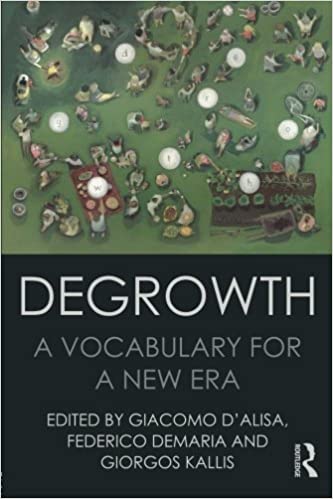
Confronting the idiom of economism head-on may seem preposterous, but slowing down under the current pandemic with ideas on frugality having caught on seems an apt time to press home the case for degrowth. After defining the term in their first book, Degrowth - A Vocabulary for A New Era, the authors take the idea forward in their second outing half a decade later by suggesting a way of living with less, however, with the aim of living differently by promoting well being, equity and sustainability. Degrowth, according to the quartet, should help people engage life journeys with patience, compassion and care for self and others, rather than investing time and resources for material acquisitions to escape the daily quota of pain, sadness and frustration. After all, how long should the cycle of sufferings remain self-perpetuating?
While the political system is obsessed with a growth-driven model based on private property, paid labor, and a consumptive market, The Case for Degrowth provides numerous cross-country examples of eco-communes, transition towns, and co-living communities that need support, strengthening, and scaling up. Spread over five sections, with an add-on section elucidating the frequently asked questions, this pithy book offers well-argued critique of the growth systems while presenting policy packages for promoting degrowth that will help people produce only as much, consume less, share more, enjoy time, and live with dignity and joy. There are clear directions being proposed in the book to make degrowth a reality, however, it by no means should be read as a euphemism for ‘green deal’ as it is a low resource use transformative process that ensures universal basic services for all, with an assured universal basic income.
Offering deep analysis, the book argues for a transformative politics that is not back-to-the-roots journey but one that provides multiple options and strategies about recreating frameworks for engaging communities in playing an active role in designing their own life support systems. Ever since it was launched at a global conference in Paris in 2008, degrowth has caught on as an idea for researchers and movements to pursue as an alternative to growth-obsessed politics. With GDP driven global economy taking a serious beating during the pandemic, the book could not have come at a more appropriate time.
The Case for Degrowth is a bold new statement on re-ordering values and resources to support the development of diverse life-making processes operating in different logics under differing conditions. The writers are convinced that by adopting diversity of approaches can resilience be achieved in the face of the existential crises. Written with empathy and concern, the book is an open invitation to its readers to play a proactive role in pushing the idea at levels that can generate political support for a non-GDP growth.
The paradigm shift in proposed policies and actions in the book take into account historical, cultural and social contexts which may have its share of pitfalls, but the pandemic has indeed shown that modest living, enjoyed in solidarity, amidst shared living is indeed a possibility.
by Giorgos Kallis, Susan Paulson, Giacomo D’Alisa, Federico Demaria
Polity, Cambridge (UK)
Extent: 151, Price: US$12.95.
First published in The Hindu, issue dated Nov 22, 2020.