Thursday, May 28, 2015

The race has just begun

As old tasks get automated away, the challenge is for the economy to not only invent new jobs but to equip people with new skills as well. 

One can either marvel the rapidly evolving digital technology or bemoan its dreadful aftermath. The pace with which work of science fiction is becoming a business reality, rapid spread of automation has revolutionized disease diagnosis and transformed online retailing, among many other technological strides. However, the flip side is that payroll processing software, factory automation, computer-controlled machines, automated inventory control and word processing has triggered technological unemployment, pulling millions of people out from the comfort of their jobs. And the digital revolution is just about bracing up for the second machine age. 

Accomplished experts in information systems and economics, Erik Brynjolfsson and Andrew MacAfee unfold the reshaping of our lives and economies in the wake of rapidly evolving digital technologies. Spread and efficiency notwithstanding, the authors contend that automation has made humans redundant in many spheres of life. Productivity and profits may have soared but wages are falling and unemployment is rising. As old tasks get automated away, the challenge is for the economy to not only invent new jobs but to equip people with new skills as well. 

Given that the full impact of digital technologies has yet to be felt, the time to act is NOW. Dazzling personal technologies, advanced diagnostic infrastructure and smart communication devices only showcase the limited bounty of digitization. Artificial Intelligence, argue the authors, is now ready to unleash the second machine age. It is a blessing, however, that computers have yet to catch up with humans on ideation, large-frame pattern recognition, and complex communication. Till that happens, and it is unlikely to happen anytime soon, cooks, gardeners, repairmen, carpenters, dentist and maids should live in peace as they are unlikely to be replaced by machines.  

Digitization is creating both possibilities and potential, but ultimately, the future will depend on what choices are made and how prosperity gets shared across the society. Drawing on latest research and up-to-date trends, Brynjolfsson and MacAfee wonder if mankind will reap unprecedented bounty or embrace greater disaster that technology, by default, harbors. The line is thin and the challenge enormous. 

The Second Machine Age is an optimistic take on the future that awaits us. Undoubtedly, artificial intelligence will cut down costs, improve outcomes and make lives better, but only when the organizational transformation would be ready to absorb the full benefits. Left to businesses alone, entrepreneurs and managers will substitute capital for labor for maximizing profits. Unless there are policies to favor inclusion of the workforce in the second machine age, companies like the Foxconn, a Taiwanese multinational electronic company, will continue to purchase robots to work in the company’s factories. 

It is not an either/or scenario but one wherein new collaborations would need to be designed to harness the best of both - brute processing power of the machine and ingenuity of human ideation. Futurists have rightly said that you’ll be paid in the future based on how well you work with robots. It is now getting clear that if humans fail to race with technology; our species will be able to destroy itself. It is one race in which we cannot have fewer winners and more losers. If that were to happen, Arthur Clarke’s prophetic words will come true: ‘The goal of the future is full unemployment, so we can play’.

A terrific book about an exciting future, that is no less scary! 

The Second Machine Age
by Erik Brynjolfsson and Andrew McAfee
Viva Books/W W Norton
Extent: 306, Price: Rs 995 

Saturday, May 16, 2015

The Yoga of our times

Yoga, as it is beamed through television channels today, is not what was written by Patanjali in the first centuries of the Common Era.

Yoga, as it is beamed through television channels today, is not what was written by Patanjali in the first centuries of the Common Era. Consisting of fewer than two hundred verses, the Yoga Sutra has virtually nothing to say on the postures and the stretching and breathing exercises that the contemporary yoga gurus have reduced the philosophical text into. In reality, Yoga Sutra is a classical work of moral philosophy, guiding men to become morally perfect in the world.  

One of the six Indian philosophical systems, Yoga Sutra is an investigation into the relationship between spirit and matter; an account of workings of the mind and ways of knowing what is true; a study of cause and effect in the workings of the universe; and a guide to salvation. The compact definition of yoga, as Patanjali had postulated, is composed of four words: yoga=citta-vritti-nirodha. A simple translation should read something like: yoga is the stoppage of the turning of thought. Since the workings of the mind are both the source and the potential solution to the problem of suffering, yoga liberates the subject from the distorting effects of the mind-stuff for attaining salvation. Drawing inferences from a dozen classical commentaries on this book, David Gordon White, a professor of Comparative Religions at the University of California reconstructs the rise, fall and rise of this perennial classic in the biography of The Yoga Sutra of Patanjali.   

White brings to light the astonishing fact that Patanjali’s classic work was not only forgotten in India for hundreds of years but its first discovery in the West was viewed with disdain too. It is believed that the onslaught of Islam in the northern part of the sub-continent, somewhere around the sixteenth century, had led to forging a new religio-philosophical paradigm between the theism of the Puranas and Vedanta philosophy that excluded all non-Vedic traditions including Yoga. Yoga Sutra’s glorious days had lasted from the seventh to the eleventh centuries, during which its popularity had stretched from Central Asia to Indonesia. Its subsequent resurrection by the British Orientalist Henry Thomas Colebrooke in 1823 saw its popularity surge in Europe and America, and predominantly in English. Could this be the reason that the yoga of India’s past bears little resemblance to the yoga practiced today?

In following the strange and circuitous journey of this timeless classic, from its ancient origins to its modern resurgence, White offers critical views on the manner in which Vedanta-inspired intellectuals of Bengal had mainstreamed Yoga Sutra. Notable amongst them was Swami Vivekananda who not only seized upon Yoga as an ideal platform from which to assert the antiquity and superiority of Indian science over the West, but used its popular demand in the United States to finance the humanitarian work he had planned for India. Vivekananda’s appropriation of Patanjali’s work set the die for much of what has followed down to the present day. However, none can take away credit from Vivekananda whose work had fashioned yoga as a cultural symbol, in harmony with the religious and intellectual aspirations of educated Indians.    

Whether or not authorship to this classic could be attributed to Patanjali is still being debated among cultural-historians and scholars, the dramatic revival of Yoga Sutra after a long hiatus remains somewhat of an enigma nonetheless. With the classic having been translated in as many as 46 languages, its readership is no longer restricted to an intellectual elite. However, the sub-culture of ‘yoga practice’ has made it reach even further. White’s exhaustive research presents authentic treatise on the remarkable journey of this classic till now, without drawing any roadmap on its future. While scholars will continue on grinding the Yoga Sutra, a mass-based sub-culture of yoga practice is providing solace and inspiration to millions. 

Based on fascinating historical documentation, Prof David Gordon White provides insights on the profound philosophy of Yoga Sutra, which is as important to comprehend as getting the breathing exercises right. To that end, White helps to bridge the theory-practice divide. 

The Yoga Sutra of Patanjali 
by David Gordon White
Princeton University Press, UK
Extent: 172, Price: £16.95 

This review was first published in The Hindustan Times on May 16, 2015

Sunday, May 3, 2015

City's Double Life

To strike a balance between religious obligations and human desires, a majority of Tehranis are forced to lie to ensure survival

Life in a city is about survival, and Tehran is no different. Survival is as much an evolutionary feature as an act of desperation, moreso when a city seems torn between tradition and modern, conflict and resolution, and truth and lies. To strike a balance between religious obligations and human desires, a majority of Tehranis are forced to lie to ensure survival. And they do so for no fear of retribution, an instinctive response to an oppressive regime that believes in interfering in the most intimate affairs of its over twelve million citizens. 

Deception has become a way of life for Tehranis of all age groups. While children are trained to deny that daddy has any booze at home, teenage girls hide their promiscuity by passionately vowing their virginity. And if this is not enough, it is a city where gangsters rule the streets and the Mullahs are known to visit prostitutes. Moral policing by the state has led the pathology of subterfuge percolate across every corner of the city. Drawn from across the spectrum of society in the city, eight characters personify the compelling stories of deceit and deception. There are intimate stories within each story, depicting the past which cannot be escaped and a future that is equally inescapable. 

The stories are located around the famous Vali Asr Street, which runs through the middle of the city, pumping life through it and spitting it out into the deepest corners of the city. These are real-life stories of ordinary people forced to live extraordinary lives: the assassin Dariush, the porn star Leyla, the gangster Bijan, the blogger Amir, the socialite Farideh, the thug Asghar, the militiaman Morteza, and the housewife Somayeh are connected by a common thread – they are all busy either running for or running from their lives, literally. Ramita Navai got to know these people while living and working as a journalist in Tehran that helped her draw intimate portraits of their survival strategies amidst unimaginable circumstances. 
 
Like each of the eight characters most Tehranis are in constant conflict, on a quest to find their real selves and to free them from the repressive environment. Far from being judgmental, the author remains empathetic towards the protagonists as she finds them irrepressible warm ‘no matter how tight the regime turns the screw’. Even their over-indulgence in drugs and sex is contextual; an irresistible response by a majority who consider themselves always doomed, lied to and betrayed. A panacea for everything from aches to boredom to joblessness, opium has become a classless drug smoked along the length and breadth of Vali Asr and beyond. It gives temporary relief to ten million drug addicts in the county, even though two million are chronic addicts. 

Sex, on the other hand, is an act of rebellion in Tehran, a form of protest. Only in sex do many of the younger generation feel truly free, asserts Navai. They have ultimate control over their bodies, if nothing else in their lives, and they have made it the weapon of revolt. It is a backlash against years of sexual repression; of having to continually lie and hide natural desires. This is a shocking portrait of a city where despite the ominous presence of a repressive state, the traditions and values are getting eroded. Political intrigues and religious beliefs have only trumped the glorious heritage of a picture postcard city. There is a hidden city within the facade of the city. 

Ramita Navai’s writing is intense and powerful, engrossing and engaging, navigating through the lives of those who are torn between hope and despair, between twists and resolutions. In drawing an honest, intimate and true portrait of the city, the author finds a strange connect with the characters she has drawn on the pages of City of Lies. Despite the painful assertion that the limitations of life in an Islamic Republic require everyone to hide aspects of their selves, the author finds herself strangely in love with the city. So much so that she kept returning to the city long after foreign media had been banned from the country.  

City of Lies is a courageous writing at its best. Written with passion and flair, the author has painstakingly unmasked the city that lies shrouded in lies. People will demonstrate, citizens will be executed, lovers abandoned and police corrupted but Vali Asr will remain a constant, stitching together the bloodlines, the clans, the kindness, the prying and the meddling. 

Though complaining is a way of life in Tehran but not many seems to be complaining as yet. Strangely enough, neither are they mourning though Tehranis are known to make excellent mourners. City of Lies leaves the reader groping for an answer to the prevailing psychology of its inhabitants. Will they be ever liberated from the intricate web of lies or have they resigned themselves to their falsehoods? 

City of Lies 
by Ramita Navai
Weidenfeld & Nicolson, London
Extent: 301, Price: £18.99 

This review was first published in the Deccan Herald, May 3, 2015.

Thursday, March 12, 2015

Prescribed living invites doctors’ prescription

Mass production, mass consumption and resultant mass monotony has resulted in mass depression.

Realizing that the French people would judge him for how happy and satisfied they felt with life during his presidency, Nicholas Sarkozy had hired some of the best brains to construct a measure of progress that went beyond GDP, and instead took into account the wellbeing of its people. It was in 2007 and since then many developed countries like Germany, Australia and Canada and some states in the USA have adopted new ways of measuring progress. The trend has slowly catching on.  

The wellbeing measures may not be perfect, yet it reflects a growing realization that economic growth and its manifestation of materialism is making millions of people joyless, anxious and, even worse, depressed. Far from resolving economic stagnation, mass production and mass consumption has resulted in mass depression. The resultant mass monotony of mass produced products has accentuated demand for new products which in turn has triggered status anxiety leading to over-consumption and over-stuffing. Diminishing marginal utility notwithstanding, multiple influences work on people to stuff their wardrobes with clothes they may not wear and homes with products which are put to use once in a while. 

Like obesity, stuffocation is turning out to be yet another epidemic. Lifting the veil on why we live the way we live, trend forecaster James Wallman constructs the compulsive history and the obsessive psychology of over-stuffing and its dreaded consequences, both on the environment and well being. It was the future president of United States, Herbert Hoover, who had planted the idea of ‘creating desire’ through advertisement as early as in 1925. By revolutionizing the counterintuitive idea that becoming prosperous is not by saving but by spending, the sagging future of the US economy could be revived. The result was a society where people thought of quantity of stuff first, and quality of life as only an afterthought.  

While sympathetic to excessive consumerism, Stuffocation provides insights on the emerging trend of de-stuffing wherein materialism is consciously being replaced with ‘minimalism’ through creative and imaginative experiments. More and more people are now realizing that they would be better off if they lived more simply – with less stuff. In numbers, around 40 million in the UK and 240 million in the US are actively ‘de-stuffocating’, opting for a life with fewer material things. That ‘prescribed living invites doctors’ prescription only’ is slowly dawning.  

Using true life stories Wallman demonstrates that consumerism has become a virtual game of snakes and ladders. The constant advertisement bombardment leaves us feeling always at the bottom of the pile looking up. And that, in a meritocratic system like ours, leaves us feeling anxious, stressed, and depressed. Yet, there are the likes of Nicodemus, Millburn and Cantwell who have devised ingenious solutions to possess only as much as was needed. Howsoever enlightening new way of living might seem, status quoist would find it less inspiring.  

Wallman is pragmatic about his manifesto for change. The solution to stuffocation is more than just throwing out the stuff and slowing down the materialistic machine. More than anything else, it needs a cultural transformation, a change in human aspirations. Stuffocation is not only inspiring and persuasive, but provocatively clever.  

Stuffocation: Living More With Less 
by James Wallman
Penguin, UK
Extent: 358, Price: £9.99 

Thursday, March 5, 2015

The King Who Never Forgot He Was A King

Had he been born a century later, he would undoubtedly have found his career in the film world. 

For different reasons, the lives of the Indian Kings and Princes have been intriguing both for the historians as well as for ordinary folks. Though he was known for his tasteful eccentricities, it remains a mystery till date why Nawab Wajid Ali Shah, the last King, had his left breast and nipple artistically exposed between the gold borders of his royal dress all the time. Shah’s portrait in the picture gallery near the Husainabad Clock Towers in Lucknow is reportedly kept behind a curtain, because it is said that a British lady had fainted after seeing the exposed nipple.  

It remains anybody’s guess whether the king was making an exaggerated point about his religious affliation or was it only to make a fashion statement. Should the latter be true, the King was surely ahead of his time? It is hard to believe if he simply wanted to be portrayed as a sensual man because according to one of his numerous descendants living in Kolkatta, the King was such a pious man that he could not allow any females to serve him unless he had contracted a temporary marriage with them, ended up marrying some 375 women by the end of his life in 1887. 

A teetotaler all his life, Wajid Ali Shah had a fascination for Krishna, and was sometimes referred to as Kanhaiya, which was reflected  through his passions for grand theatrical events. Had he been born a century later, he would undoubtedly have found his career in the film world, with the chance to realize, on an epic scale, the theatrical presentations he had directed in Lucknow – some of which lasted for over a month. History has seemingly been unkind to him, not crediting him as one of the most important cultural catalysts of his day and for the ebullient creativity he represented. 


British historian Rosie Llewellyn-Jones reconstructs Wajid Ali Shah's life through his numerous wives, his menagerie, the trauma of annexation, his uncurbed extravagance, the frustration of his sons and the dismantling of his household after his death. The actual reign of the poet-ruler had lasted only nine years but Wajid Ali Shah spent the last 30 years of his life as a deposed ruler (on pension by the British East India Company) at Garden Reach near Calcutta, ruling a mock-kingdom with 6,000 subjects. Even in exile, he had continued the customs of the royal court, neither forgetting that he was the King nor allowing others to forget it either. 

It is a brilliantly told historical account of an eccentric King who remained woefully misunderstood during his time, but one who comes out as a man of character who lived his life on his own terms.  

The Last King in India: Wajid Ali Shah 
by Rosie Llewellyn-Jones
Random House, New Delhi
Extent: 314, Price: Rs. 599 

Wednesday, January 14, 2015

Beyond flesh and mortality….

Each story begins as a perfect example of ‘romantic love’ between a man and a woman, transcending into ‘intense passion’ before culminating into ‘spiritual ecstasy’. 

As much a part of folk literature as of contemporary rendering, the love stories from the land of five rivers continue to linger. From Heer-Ranjha to Sohni-Mahiwal and from Sassi-Punnu to Mirza-Sahiban, the heart rendering stories of immortal love continue to get told and retold, frequently captured on celluloid, for their ever-lasting appeal in a world that is increasingly been torn apart by hatred and violence.

The broad outline of the stories is no secret, but the essences lies in their effervescence - these stories of love stretch beyond flesh and mortality and grow upwards to attain spiritual bliss. The enduring appeal of these legendary stories has been captured by Harish Dhillon in the updated version of the book, published nearly two decades after its first edition. An exposition of Sufi philosophy, each story begins as a perfect example of ‘romantic love’ between a man and a woman, transcending into ‘intense passion’ before culminating into ‘spiritual ecstasy’.

In his near poetic rendition, the author makes the characters come alive to share their unfettered emotions. Mirza’s emotions are laced with nuggets of wisdom: ‘The beauty of the body is but for a day – it is the beauty of the mind and the spirit that will remain long after the beauty of the body has passed by.’ Each story has a sad ending though, but in the words of Shelly, ‘our sweetest songs are those that tell of saddest thought’. Profound and touching in its own way, each story speaks of the search of the soul. Part of its rich cultural and literary heritage, these engrossing stories have shaped the mindscape of people of Punjab. How true are the prophetic words of Mahiwal which personify the essential character of people living in the land of five rivers: ‘the only measure of immortality that we can ever gain is in the way we affect the lives of others.’  

The stories are all but known but it is the depth of research and reflection that lends freshness of purpose to each story. Why the action of almost all the stories took place along the banks of river Chenab? Was there something magical and unique about the waters of the Chenab? It is assumed that with Multan being a great centre of Sufi learning, it was natural for its influence to flow along the river. It further reflects that rivers not only provide heart-soothing serenity but heart-pounding excitement for romance to flourish and attain dizzy heights along its banks. One might wonder if the present decline in quality of love is manifest in the deterioration of our rivers!

Harish Dhillon may be modest in admitting that the strength of the narrative lies in the mystical appeal of the stories, he nonetheless leaves an indelible mark in narrating the drama, romance and tragedy in the historical backdrop of each story. Not much has changed since the tragic end of these love stories though. The world has become more intolerant, where love between young souls is still forbidden.

Love Stories from Pnnjab
by Harish Dhillon
Hay House, New Delhi
Extent: 272, Price: Rs 350

Sunday, December 14, 2014

Cheaper products carry a hidden price tag

In a free market economy the incentive to externalize costs is so huge that the seller and the buyer get into an unapologetic understanding to get away with it.

Cheaper products are a marketing gimmick. Enticing nonetheless, deep discounts on popular brands release pent-up demand too. Less expensive means people buy more than what they really need or want. ‘Cheapness' has been an enigma. While one avoids buying anything considered 'cheap', striving for cheaper and cheaper stuff remains alluring. So much so that after a real bargain the stuff is showcased to friends and family for guessing its real 'price'. Lowest possible price paid for a quality product is exhibited as an individual's shopping prowess.    
 
'Cheapness is an illusion', says Michael Carolan, who teaches sociology at the Colorado State University, USA. The real cost of low price is alarmingly high because low price neither reflects the real cost of production nor accounts for all (environmental) factors contributing to the production process. Be it cheap food or free plastic bags and an affordable car or a smart computer, the true cost of the product is not paid by the buyer but by the society at large. 

The shopper may not pay at the time of purchase but eventually one has to, as initially externalized cost and risks of production finally get socialized. Given the egregious economy wherein the sellers and buyers do not fully pay for their good fortune, it is left for the future generations to foot the inflated bills. The cumulative cost to future generations, a UN study estimated in 2008, could be as high as US$2.2 trillion on account of environmental damages caused by some 3,000 largest publicly traded corporations in the world.

Come to think of it, cheap in itself could be terribly expensive in the long run. But in a free market economy the incentive to externalize costs is so huge that both, the seller and the buyer, get into an unapologetic understanding to get away with it. It offers a comparative advantage to both, however, at tremendous cost to those who have to pay for it now or later. Carolan questions the economics status quo, arguing that a system that socializes costs for the benefit of few can do little to actually enhance well-being for the majority.

Cheaponomics is a revelation! Drawing on a wide range of examples, Carolan unfolds the compulsive economy of cheaper goods which create a false sense of consumer celebration by making large social and income inequalities tolerable. Cheaper products reduce choice but encourage over consumption, adding to urban chaos through mass wastage. Over-consumption is at the root of present-day crises, from growing urban trash to mounting atmospheric emissions.  

Carolan concludes an engaging story with a set of practical recommendations. Governments ought to incentivize accurate pricing and enable affordability as the key to price rationalization in the market. Real cost may make goods expensive in the short term but not over the long term as these would be designed to last longer and avoid wastage. Affordability is about enabling, about capabilities and holistic well-being rather than the shallow freedom of cheap goods!

Cheaponomics
by Michael Carolan
Earthscan/Routledge, UK
Extent: 320, Price: £15.99

Thursday, November 27, 2014

Blood stains on the fabric of life

Will the market become cosmos, leaving no alternative other than being sucked into its constantly expanding frontier?

There are two reasons for the garment industry in Bangladesh to flourish - cheap labor and a favorable climate that is conducive to producing unique quality of fabric. While climate is what nature has bestowed on the deltaic nation, cheap labor has been a consequence of labor exploitation at the globalized market place. Working for wages as low as Rs 10-15 per hour, some ten million impoverished men, women and children toil under inhuman conditions within some 5,000 garment factories in the ‘unlivable city’ of Dhaka to keep the country’s political economy afloat. While 10 per cent of parliamentarians are factory owners, as many as half have some financial interest in the garment industry.  

The irony is that while the leaders of the country have worked overtime to protect the industry that fetches 80 per cent of the country’s foreign exchange, they have exhibited uncanny insensitivity towards those upon whose tireless work their own well-being depends. The net result is that a vast pool of skilled and semi-skilled workforce has become victims of political apathy and economic violence. Song of the Shirt is a spine chilling account of the faceless millions who have remained trapped in the cycle of industrialization, de-industrialization and re-industrialization that the unsuspecting weavers of Bengal have gone through. Delving into historical narratives, Jeremy Seabrook brings to light Britain’s coercive trade policy which while protecting textile factories in Lancashire had reduced the weavers of Bengal to abject misery. 

The misery has persisted nonetheless; the post-independence reindustrialization has only been a caricature of peoples’ longing for sufficiency and security. Unlike the textile works of Lancashire who could retreat into their traditional past following the closure of textile mills, the workforce in Dhaka has only watery misery of floods and cyclones to fall back upon. If cheap labor appears anywhere else in the world, the work flying away will force their descent into destitution. With the trade unions having been systematically weakened, collective power to protect the workforce from economic violence doesn’t exist. 

Travelling through the cities, into the factories and across the lives of people who weave the economy of Bangladesh, Seabrook provides painful details of their shattered present and an equally uncertain future. Millions who migrate to escape the endless cycle of floods and cyclone soon find themselves captive inside the flammable buildings in the apparel capital. It is a tragic irony that in the last decade, at least 500 workers, mostly women, have been claimed by fire accidents. Those who escape water get greeted by fire! Song of the Shirt is a poignant tale of hopeless illusion and unending exploitation which sustains itself on an imagined edifice of affluence amidst overcrowding, violence and degraded living conditions. 

Written with passion and anguish, Song of the Shirt is a painstaking work that narrates the untold story of a society that has been in perpetual transition for last two hundred years.  Rich in detail, Jeremy Seabrook leaves the reader with moral predicament as well as an uncomfortable question: will the market become cosmos, leaving no alternative other than being sucked into its constantly expanding frontier? 

The Song of the Shirt 
by Jeremy Seabrook
Navayana, New Delhi
Extent: 288, Price: Rs 495
(http://navayana.org/product/the-song-of-the-shirt/)

Wednesday, October 29, 2014

Getting the most out of what we have!

In a world where growing knowledge confronts as much ignorance, the idea of scarcity offers clues on managing our lives better during abundance.

When an economist and a psychologist come together to undertake an intellectual endeavor, the outcome shatters many myths about everyday living. Together they manage to merge academic rigor to explain the most fundamental problems in all walks of life viewed through the science of scarcity, which the authors claim is still in the making. The lonely are lonely, dieters are plump and busy are busy because they are in the ‘scarcity trap’ and lack the capacity to organize their lives.  

Scarcity captures every mind but the authors stretch the notion of fiscal scarcity to include social scarcity and cognitive scarcity as well as scarcity of time and calories to name a few. The multiple implications of scarcity not only make us dumber but cloud our cognitive abilities to come on top. Far from making people more effective, as many would believe, scarcity leaves us with reduced fluid intelligence and more impulsive actions. Not without reason, scarcity leads us to borrow and pushes us deeper into scarcity. Using stories from daily existence and studies from diverse social settings, Sendhil Mullainathan and Eldar Shafir conclude that the feeling of ‘less’ distorts our vision and judgement. 

Scarcity is loaded with fresh insights, helping the reader pull comparable moments out of one’s own experience. In a world where growing knowledge confronts as much ignorance, the idea of scarcity offers clues on managing our lives better during abundance such that there is no slackness when scarcity confronts us. Scarcity can make us wiser provided trade-off thinking is thoughtfully applied. Afterall, scarcity is largely an outcome of environmental conditions that can be managed. Scarcity should make us experts, even if in a limited manner.

Don’t we all become experts when it comes to managing scarce space in our suitcases before undertaking a journey? Mullainathan and Shafir wonder why can’t this expertise help the poor know the value of a dollar, the busy the value of an hour, and dieters the value of a calorie? In a way, the idea of scarcity offers good news because it can help us organize our lives better and design efficient systems around us. Because, like poverty scarcity is unlikely to go away as abundance and scarcity co-exist in an unholy alliance.  The trouble with scarcity is that it not only captures the mind but perpetuates itself.    

Scarcity is a real page turner, overflowing with fresh insights and simple suggestions to transform the way we live and manage ourselves. If you think traffic on the road is clogged in a scarcity trap and that there is no way out, you may need to put on your ‘scarcity cap’ to wriggle out of it. The authors argue that should all the cars were to go at the same speed, not only will the traffic flow be smooth but more cars can be accommodated on the road as well. It is the variation in speed of cars that causes congestion, as drivers vie for limited space (a reflection of scarcity) on the road. 

Scarcity is often associated with dire consequences but not when it comes to Mullainathan and Shafir who consider it as a perfect trigger to enhance our abilities to make better choices. Scarcity is a must read, brilliant and engaging.   

Scarcity: The True Cost of Not Having Enough
by Sendhil Mullainathan and Eldar Shafir
Penguin, UK
Extent: 288, Price: £9.99  

Saturday, September 27, 2014

Tales from the uncivilized world

The writings on offer are not those we have often grown up with but those which can make us feel grown-ups.

If you believe that we, as a civilization, are at a juncture from where the future looks certainly bleak, this title-less book is for you. If you are close to being convinced that tainted vision of the world is loaded with untrustworthy subjectivity, the writings in the book can surely stir your latent imagination. And, lastly, if you are not overtly averse to Ralph W Emerson’s words that ‘the end of the human race will be that it will eventually die of civilization', the uncivilized writings – and poetry – in this volume will surely make you sit up, think and take note of. Dark Mountain (written as DaRk) stretches beyond what Nobel Laureate Herbert Simon called `bounded rationality' - the limited capacity of the human mind to comprehend objectivity. 

It is an enormously rewarding read but not an easy one. While some sections are easy to comprehend, others sections could be strenuous. Partly because you suddenly find yourself entering a world which you never thought it existed and partly because we are conditioned to reject what lies beyond our cognitive world. The way one looks at it, Dark Mountain could either be a book of despair or a testimony of hope. Undoubtedly, however, it could easily be the first step towards ‘unlearning’ – a rediscovery of ‘self’ which is not the ‘self’ that modern economics has taught us we have. 

Launched in 2009, this is the fourth book from the project that grew out of a feeling that contemporary literature and art were failing to respond honestly or adequately to the scale of our entwined ecological, economic and social crises. A growing group of writers, artists and thinkers contribute to each volume. The stories they offer are not those we have often grown up with but those which can make us feel grown-ups. 'If you are seeing the people by what they don’t have, then you are not seeing them'. The thrust of the argument is to see beyond, as there is a world waiting to be explored, perceived and understood. 

Dark Mountain questions our faith in progress and our unending belief in being control of literally everything. There is little sign of this myth crumbing any time soon, though. Yet, there is a need to acknowledge that we are living through uncertain times and that we alone have to deal with the consequences. Dark Mountain is a unique undertaking that nobody knows where it will lead to. Yet, it may be worth being part of this process of un-civilization.  

DaRk Mountain Book 4
by Dark Mountain Project, UK
Extent: 320, Price: £15.99

(Readers can help themselves learn more about the project by visiting http://dark-mountain.net/)

Saturday, September 20, 2014

It is the shape that really matters!

There is nothing absurd or off-limits in the world of science.

The title of this book might sound like an oddity, scandalizing reader on the impropriety of the question. Could it not have been one of those questions left unsaid and unexplored? Not for evolutionary psychologist Jesse Bering though, who considers nothing absurd or off-limits in the world of science. Impolite it might sound, the salacious query led to incredible evolutionary insights that surprisingly began to attract scientific attention only recently. Dangling precariously outside the human body, human phallus is considered a highly specialized tool manufactured by nature over hundreds of thousands of years of human evolution. 

Taking readers on a bold and captivating journey, Bering seeks answers to some of the most taboo questions: Why is it pretty big in comparison to the privates of other apes? Why does it have a distinct mushroom-capped glans? Why are the unattractive testicles uneven in size? Quoting extensively from published research by Gordon Gallup and others, the author concludes that size not only helps stretch its reach inside the female body but together with the bulbous glans it performs what in the field of evolutionary psychology is called ‘reverse engineering’. 

Considered to be a by-product of adaptation that gives humans a competitive edge in terms of their reproductive success, reverse engineering performs a special removal service by expunging any foreign sperms lying in there. The penis may have evolved its shape to lessen the chances of one becoming the unwitting surrogate father to another man’s kid. It might shock those who consider our species as being blissfully monogamous, but some degree of fooling around has been there ever since. 
   
Drawing from his published essays in Scientific American and Slate magazines, Bering presents a selection of astounding oddities of human sexuality that can enliven any drink party. From examining male reproductive anatomy to exploring dirty brain science and from intriguing sexual fetishes to the Gayer science and more, the book offers as much hard science as entertaining speculation within the framework of evolutionary psychology. Despite some of its outrageous conclusions, the book is worth an exhilarating ride. 

Himself a gay, Bering considers this ‘condition’ to be one of the reasons why the brain of a gay person is as slow as molasses when it comes to finding a way around. Never ask a gay man for directions. How to distinguish a gay person from a straight man? Evidence suggests that gay people produce different armpit odors from straight people and that these scents are detectable. If nothing more, Bering has been successful in arousing curiosity around some of those aspects of everyday existence that rarely merit popular imagination. 

I am confused whether or not to recommend this delightfully readable book. All I can say is: Ball’s in your court!

Why is the Penis shaped like that?
by Jesse Bering
Transworld Books, UK
Extent: 350, Price: £8.99 

Wednesday, September 10, 2014

Just the right amount of wrong

Las Vegas, the Sin City, has altered perceptions: gambling substitutes for income, night is interchangeable with day and, the scale of excess refutes the idea of scarcity

It is a poignant tale of greed, chicanery, betrayal and manipulation which created an edifice of affluence in the middle of a desert. The public-private plunder had the sanction of the State for robbing the natives of their rich cultural inheritance. It was a misfortune that the natives were sitting atop the biggest coal reserves of the time that the political-industrial complex had aimed to wrest. 

Projected to the outside world as an epic struggle over land between two Indian tribes, it has instead been a divide-and-conquer game played in disguise by the powerful and the corrupt. Judith Nies narrates the shocking facts behind the making of Las Vegas, the gambling capital, where the dark markets of America intersect with the upper world markets of ‘free-market capitalism’. Set in the late 19th Century, the phenomenon of usurping rights of indigenous people by giant corporations has continued ever since. In what was termed ‘low-intensity conflict’, thousand of tribes were driven away at gunpoint to labor camps, their sheep slaughtered and their children jailed. 

Unreal City is a chilling account of the tribes’ struggle and the right amount of wrong by the government to edge out the so-called impoverished societies for the subsequent creation of Las Vegas, the Sin City, which has only altered perceptions: gambling substitutes for income, night is interchangeable with day and, the scale of excess refutes the idea of scarcity. But it is the scarcity that is haunting the city that gets 39 million fun-loving visitors each year. Having sucked it’s deep aquifers and with shrinking Lake Mead (created by the Hoover Dam) on the Colorado river not able to meet the city’s allocation, a multi-billion dollar water pipeline has been planned to tap a mountain aquifer 250 miles away to not only keep fifty golf courses green but to keep the showers and flushes running in fourteen of the largest hotels in the city. There is nothing ‘real’ about the city. 

Award-winning author Judith Nies questions the wisdom behind the incredible cost of sustaining an unreal city. Located in the middle of the Mohave Desert, a water-guzzling city with just four inches of annual rainfall can only suck the nearby rivers and far-off aquifers dry. Shockingly, the new pipeline to feed the Sin City will be the only project in the world that lifts water twenty-nine hundred feet.  Curiously, the city residents don’t seem anxious (like most urbanites elsewhere in the world) about where they get their water from, but support the political-business nexus that controls infrastructure. At the end, it is the business that flourishes at the cost of problems which only continue to amplify. No wonder, company like Bechtel, which started with two mules and a slip grader in 1898, is now one the largest multinational corporations.

Written with passion and precision, Unreal City is a painstaking work that narrates the undertold story of (mindless) development albeit euphemism for deceit, betrayal, corruption and despoliation. Apparently written for the North American audience, the first of the three sections of Unreal City may remain somewhat of a geographical puzzle for readers elsewhere. Rich in detail, Judith Nies painstaking narrative raises uncomfortable question which are often considered ‘unpatriotic’ and ‘anti-national’. 

The Unreal City 
by Judith Nies
Nation Books, New York
Extent: 292, Price: US$25.99 

Wednesday, August 13, 2014

How not to manage rivers

The great challenge for this generation is to figure out a way to reverse the downward corkscrew of our rivers before we reach a point where there is nothing left to save.

Dictatorships are loathed the world over for the fatalities it commits on people but rarely have democracies been reprimanded for desiccating the living rivers. Within the rubric of peoples’ republics, it is the people who have been distanced from the rivers they have grown up with. Isn’t it a fact that an acclaimed republic, the USA, has led the world in inflicting grievous damage on its rivers, with hardly any river reaching the sea?

It indeed is! In its two centuries of experience in manhandling rivers, the U.S Army Corps of Engineer has dammed, diverted and dried up nearly all its rivers. It never occurred to this elite force that moving water could also be a resource; pouring concrete to impound or divert flows has been euphemism for water development instead.  With an attitude termed ‘water hubris’ guiding river management, some 3.3 million small and big dams have converted free-flowing rivers into a series of interconnected reservoirs in the U.S. None of these projects have lived up to the promise of being self-sustaining though; annual maintenance expenditure alone has tossed the cost-benefit calculus haywire. 

Political currency of dam building and river engineering sustains itself; water projects are viewed as instruments of power, prestige and political gamesmanship. To get a sense of how water hubris has been nurtured, Daniel McCool, Professor of Political Science at the University of Utah provides bio-sketches of two leading agencies: the U.S Army Corps of Engineers and the U.S Bureau of Reclamation. Through their relentless pursuit to ‘curb the sinful rivers’, these two agencies could turn water hubris mentality into a moral right for the society, almost in religious terms, to conquer rivers. No wonder, calls for new water projects are always accompanied by dire projections of an impending ‘water crises’. That the actual crisis is that of water management gets subsumed under the din. Discomforting similarity can be found in the current river/water policy scenario in India.   

Including other ecological concerns, the collapse of the Teton Dam on the World Environment Day in 1976 may have been the tipping point for a change that is currently sweeping America. From a 27 km long reservoir, 80 billion gallons of water swept through the 305 feet high earth-filled dam killing about a dozen people in Rexburg, Idaho. Ironically, the Machhu Dam disintegration in Gujarat in 1979, which killed as many as 25,000, hasn’t had any impact on the prevailing water hubris in India. Apathetic attitude is indeed appalling!

The Teton dam has long perished but it has been officially recognized that there are 15,237 dams in the US with high hazard potential. Under the ire of public outrage as many as 890 of these dams have been dismantled till date; water hubris is slowly giving way to new water ethics in the U.S. Inspiring account of citizen’s triumph against the institutionalized annihilation of rivers is worth emulating. 

Profiling such individuals as ‘instigators’, McCool confirms that not only has status quo been challenged but that rivers are returning to their free-flowing condition by their efforts in the U.S. River instigators are working their way through a maze of corrupt system lathered with special-interest money in turning river restoration into something of a cottage industry. There are as many as 2,500 non-profit river groups partnering with the agencies which were earlier building dams in restoring rivers to their pristine status. The process is transformative!

River Republic is an authoritative exposé on political economy of river tempering; lucrative principles of such an economy appeal to vested interests everywhere. However, McCool stresses that the great challenge for this generation is to figure out a way to reverse the downward corkscrew of our rivers before we reach a point where there is nothing left to save. 

Personal anecdotes and insightful analysis make it an important book. A must-read for all those who are seeking answers that help keep rivers flow freely. River Republic has essential lessons for entrenched water bureaucracy. 

River Republic: The Fall and Rise of American Rivers
by Daniel McCool
Columbia University Press, USA
Extent: 408, Price: US$ 26

This review has also appeared on Anthem EnviroExperts Review, coordinated by Prof. Larry Susskind of MIT  

Sunday, July 27, 2014

‘We’ in favour of ‘I’

Our tendency to admire the rich instead of the virtuous is at the core of the corruption of our moral sentiments.

We live in the times when the object of each moment is first to record oneself  as having been there and second to broadcast the result to as much of the rest of the world as possible. With the smartphone at our service people click away with the lens pointed at themselves and post the visuals on social networking sites, imagining that all their other friends would be fascinated by what they had for breakfast or how they spent their weekends. Holding a mirror onto us, the University of Cambridge philosopher Simon Blackburn reflects that the real picture could be quite the opposite, akin to what David Hume would say: ‘A man will be mortified, if you tell him he has a stinking breath; though it is evidently no annoyance to himself.’

The arrogant belief that one is oneself the center of other people’s concerns and interest has become an all pervasive feature of the social world. This kind of narcissist’s self-esteem that is over-dependent on the opinion of others makes a person so fragile that it quickly resorts to anger, aggression, despair or paranoia when that praise falls into short supply. Taking liberal inputs from the work of Kant, Aristotle, Rousseau and Milton, who pop in and out of the pages, Blackburn explores self-love in its diverse manifestations. 

This brilliant book is about what we should make of ourselves for which the author takes a measure of ‘pride, self-esteem, vanity, arrogance, shame, humility, embarrassment, resentment and indignation’ in light of its implications on ‘integrity, sincerity and authenticity’. Mirror, Mirror offers a lively philosophical commentary on good and bad forms of self-esteem, helping the reader take a grip on the flip side of ‘selfie’ as connected to the tragic commodification of social life. Blackburn’s measured analysis does not draw any conclusion though, because the complexity in itself is highly instructive. After all, living is a process and not a product.  

For the self-esteem industry - fashion, cosmetics and plastic surgery - life is as good as a product. Applying carefully selected images, L’Oreal’s brilliantly successful marketing slogan ‘because you are worth it’ is both provocative and persuasive. Blackburn is personally irritated by the vacuous diktat and laments that it holds good for self-obsessed fragile personalities. While condemning the iniquities of the beauty industry, the author contends that it only leaves self-hood destitute. Even if one day the mirror on the wall tells us that we are the fairest of all, still we remain uneasy, for at any moment it may reveal someone else to have overtaken us. 

Blackburn’s grasp on the subject is impeccable and his lucid narrative is loaded with nuggets of wisdom: ‘Human relationships become structured around envy and spite from below, arrogance and contempt from above. It is our take on our own relative situation that bothers us, even to the point where it poisons our life’. The book provides enough resources for self-correction, a search for true self based on a hard process of analysis, discovery and purification. Unless we are idiots sky-high in our self-hood, thinking a way out of it is a clear possibility. 

Our tendency to admire the rich instead of the virtuous is at the core of the corruption of our moral sentiments. Unless we pull ourselves out of such moral elation, self-hood will continue to cast its shadow on us. It is a work of philosophy, beautifully executed.

Mirror, Mirror
by Simon Blackburn
Princeton University Press, UK
Extent: 209, Price: $ 24.95

Wednesday, July 16, 2014

On the verge of…..

There is every reason to believe that if humans had not arrived on the scene, several extinct species like the wild horses and the woolly rhinos would be there still. Yet, humans ought to be given credit for pulling some of the species like the Panamanian golden frog, the great auk and the Sumatran rhino from the verge of extinction.

But extinction as an idea rarely registers in popular perception. It may have occurred in prehistoric times, most would say, but it is inconceivable that extinction could be as much a present-day phenomenon, with humans playing a catalytic role in it. Yet, estimates indicate that a quarter of all mammals, a fifth of all reptiles and a sixth of all birds are headed toward oblivion.  In fact, signs of extinction could just be found in our own backyard. Isn’t the lowly house sparrow seen less frequently now? 

Mass extinctions seemed to take place at regular intervals of roughly twenty-six million years but by loading undesirable gases and chemicals into the biosphere human civilization has indeed triggered early extinction of some 20 to 50 per cent of all living organisms and plants on this planet. Reporting from the frontlines of collision between human civilization and ecosystems, Elizabeth Kolbert warns that mankind is in the midst of what biologists call the Sixth Extinction and it is solely humanity’s own doing.  Bringing field reports from the Andes, the Amazon and the Great Barrier Reef and presenting accounts of species preservation in many zoological parks, Kolbert contends that pace of extinction far exceeds efforts in conservation. The signs are indeed ominous!

Biological oceanographer Ulf Riebesell adds to it by arguing that the time for the sixth extinction is indeed imminent. Each time during the previous five mass extinctions, the overall biodiversity was at its lowest and there is enough evidence that that situation of reduction in biodiversity is fast approaching. Immensely readable, The Sixth Extinction is a painful investigation of the most terrifying extinction in the history of mankind. 

It is narrative journalism at its best, diligently researched reportage presented with precision and flair. Kolbert has an eye for an image, an ear for an anecdote and affection for the worst. The species Kolbert chose to write about are myriad and varied. It is an intelligent work that celebrates creation and warns of the horror of extinction that is not too far away.  The historical retelling is an imaginative take based on files, documents, letters and research papers. The author goes to great lengths to tell us that this is a book of extinction, in which distinct locations have been used to create settings. Kolbert has used facts-dipped-narrative to good effect, making the backdrop, the time and pace of the incidents palpable.  The details are truly bedeviling which make it a must read book on the uncertain future of the mankind! 

The Sixth Extinction: An Unnatural History
by Elizabeth Kolbert
Bloomsbury, UK
Extent: 319, Price: Rs 399 

Saturday, June 21, 2014

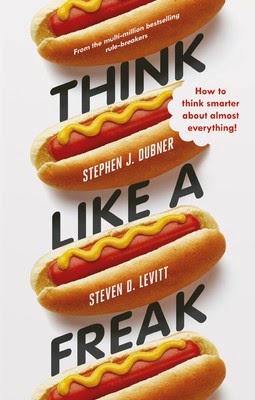
Freaks like to have fun

You too can have fun if you think like a freak. For a vast majority the idea of fun connotes that you aren't serious. In reality, however, there is no correlation between appearing to be serious and actually being good at what you do. A freak is what an ordinary is not and is therefore looked down upon by the ordinary, the vast majority.  

Barry Marshall was indeed a freak. Not convinced that ulcers in the stomach are caused by stress or spicy foods, this Australian doctor set out toward finding the root cause of illness rather than simply swatting away symptoms. The US$ 8 billion ulcer industry was not too pleased with what Marshall was up to. By infecting himself with ulcer, perhaps the only person to have done so, Barry Marshall was helped by his colleague Robin Warren in uncovering the bacterial cause of ulcer. For reliving ulcer patients from a lifetime of doctors’ visit and unrestricted consumption of expensive Zantac, both were awarded the Nobel Prize in 2005. 

Not all freak activities could land you with a Nobel but being freak will surely make you do more of what you love to do. You will think about it before you go to sleep and as soon as you wake up, without carrying undue heaviness on your mind. A freak sees things from a literally new angle, often ends up gaining an edge in solving a problem. It is this relentless curiosity of an eight-year old in you that the world may not like, calling you a crank and even avoiding you, something that a freak should get accustomed to. 

Thinking a new angle can fetch you a fortune! A lean and thin Japanese, studying economics, could double the world record of eating maximum hot digs and bun (HDB) in 12 minutes. Before he entered the Coney Island contest, the record stood at little over 25 HDB and one could imagine 27 or even 28 HDB to be the new record. But the 23-year old Takeru Kobayashi ate 50 HDB, more than four hot dogs and buns per minutes for 12 straight minutes. In achieving such a rare feat, Kobayashi had thought about the problem from a new angle. Avoiding the obvious question:  How do I eat more hot dogs? Kobayashi had posed a different question: How do I make hot dogs easier to eat? Only be redefining the problem was he able to discover a new set of solutions.    

Clearly, both Levitt and Dubner continued to have fun ever since they published their first two books – Freakonomics and Superfreakonomics. The first two books simply used data to tell stories, throwing light on parts of society that often lay in shadow. Those who have read the previous books may find the latest a bit less exciting, as it is somewhat prescriptive. Though not a self-help book, this book in the series tries to offer some advice that may occasionally be useful. It seems the journalist Dubner had more say than economist Levitt in this book, ‘economics’ has disappeared in favor of ‘freak’ from the title, encouraging the reader to think a bit differently, a bit harder and a bit more freely.    

Yet, it would be hard to imagine if anyone will aim the penalty kick at the center even when it has been statistically proven that the goal keepers jump toward the kicker’s left corner 57 per cent of the time, and to the right only 41. But sometimes in life going straight up the middle might be the boldest move. Who knows! The authors contend that the only way to have fun is to let go the conventional wisdoms that torment us; let go the artificial limits that hold us back; and let go the fear of admitting what we don’t know. Think Like A Freak makes interesting, absorbing, engaging, and somewhat reflective reading. 

Think like a Freak
by Stevan D.Levitt and Stephen J.Dubner
Allen Lane, UK/India
Extent: 268, Price: Rs. 499

The Limits to Extraction

The Club of Rome had shot into fame with its first authoritative report The Limits to Growth, released in 1972 The seminal report on the future of mankind had not only triggered a hot debate but degenerated in all-out smear campaign.. The public perception on the report was nothing more than a series of wrong predictions made by a group of deluded scientists. So much so, subsequent reports by this global think tank did not merit much attention.

Extracted is the latest report from the elite club. Had The Limits to Growth attained popularity, the title of this report could easily have been The Limits to Extraction. However, the nature of the report has remained much the same. Digging out the history of mining, from the prehistoric days to the modern age, the report suggests that mankind has almost extracted almost the entire (cheap) mineral resources alongside plundering of the earth’s ecosystems and displacement of millions in the process. It is one of the biggest global industries but the gradual depletion of low-cost minerals, including fossil fuels, is fast becoming a major limitation to economic growth. As high grade ores are extracted first, it will become much more expensive to produce most mineral commodities in future. Given the growing demand for precious metals and rare earths, a resource war is likely to emerge among countries that hold monopoly over mineral deposits.

Since everything we use cannot be grown, the same must be mined. Therefore, the political economy of mining makes it an important growth engine for most countries. China has 97 per cent of all active rare earths, including exclusive deposits of molybdenum. South Africa holds 82 per cent of global platinum. China leads countries like Chile, Australia and Argentina in global copper output. Tibet has become the new mining destination for China. Under a new regime, India intends to go full throttle to extract its mineral deposits. 

Extracted is written by a team of experts, headed by Italian scientist Ugo Bardi. The report says that deposits of many high-grade ores are running low: copper, zinc, nickel, gold, silver and others are expected to reach their productive peak within less than two decades. Not only will it affect our lifestyles but agriculture production could decline as well. By the time the world wakes up to the impact of mining, plundering of earth ecosystem would have caused lasting impact by contributing to the climate change. 

The solution, says Bardi, is to replace costly minerals with cheaper ones; recycle as much as possible, and generate energy through renewable energy sources such as sun, wind, and water. It is not far when the mining machines and the drilling rigs will disappear without corresponding decline in the demand for minerals. 

Written for the consumptive generation, Ugo Bardi has dedicated the book to his son, who is a geologist. 

Extracted
by Ugo Bardi
Chelsea Green Publishing, USA
Extent: 273, Price: US$ 24.95

A shorter version of this review has also appeared on Anthem EnviroExperts Review, coordinated by Prof. Larry Susskind of MIT  

Saturday, May 24, 2014

Making sense of one's surroundings

In a predominantly growth-obsessed market-driven consumerist culture, the environment as a subject has remained at the margins of popular perception – arcane to some and obscure to others. Environment no longer registers! Even if it does, it is often from the perspective of highly polarized environment-development debates. That environment sustains all life forms rarely merit a majority concern. 

Why is modern living distanced from the environment? Could near absence of inter-generational transfer of empathy towards environment be the prime reason! Stories, both oral and written, have ceased to be the channel for transferring the subtleties of our inter-dependence on nature and myriad other life forms. Stark monetization of human existence has further reduced environment into a set of by-products and services that can be traded. No surprise therefore that environment has been pushed to the margins of social consciousness with the riches of nature being squandered for petty gains.     

Through his collection of refreshing short stories, noted Kannada writer K P Purnachandra Tejasvi connects the civilized with the wild, evoking sentience towards what is often considered ‘given’. Set amidst the forest adjoining his village Mudigere in Chickamaglur district, each of the fifteen stories are encounters in the wild, capturing the innate intelligence of various animals in interacting with humans. The strange behavior of the jungle fowl; the mythical existence of snakes; the defense mechanism of the mud tortoise; and the amazing commonsense of the simians provide compelling insights on the virtues of co-existence. 

Considered as one of the finest prose writers, Tejasvi’s stories are neither obtrusive nor preachy. Full of wit and humor, he delightfully transforms real-life incidents in the forest into stories which have environment as the central character. The storyteller doesn’t lay undue emphasis on environment, leaving it to the reader’s imagination to create possibilities in his or her own depths. These are not just stories but experiences in the wild, making the reader aware about environment even without realizing it. The stories neither compete nor negotiate an existing situation, but create an enduring relationship between the reader and the human/non-human characters. 

There is unmistakable hint of richness lurking in each of the stories in The Story of My Environment. Tejasvi has an exceptional sensitivity towards environment which together with his comic genius helps transform this collection into a work of art. As a tribute to Tejasvi’s brilliance, this collection of short stories is 'highly recommended' for readers of all age groups!

The Story of My Environment
by K P Puranachandra Tejasvi
Pustakaprakashana, Mysore
Extent: 192, Price: Rs 140

Friday, May 23, 2014

The days of the jackals!

Are the rich, educated people as clever as jackals? Dressed in the garb of development, with the laws to their side, don’t they devour fields and forests to create a new social class – of the disposed and displaced? Forced to bear it with gritted teeth and suppressed whimpers, the injury of displacement has left permanent scars on the souls of millions! In this award-winning novel, Vishwas Patil lends voice to the pain and anguish of the people of Jambhli, who have been ousted to make way for the construction of a large dam.   

Close to reality, the saga of resistance conjures up multiple images of people who refuse to surrender their ancestral land to the juggernaut of development. Rooted to their cultural inheritance, they question the veracity of forced relocation which in no way can compensate the sweat that they had poured into their lands. Caught in the rehabilitation trap, the Jambhlikars find themselves battling petty politicians on one hand and apathetic officials on the other. Patil’s accomplished prose and fine sensibility captures their unending ordeal. 

Utterly relevant to our time, the heart-rending narrative exposes the system that acts like a ghost, riding on poor’s neck and pushing them deeper and deeper into the quicksand till they perish. Since the dams get choked with silt much before the oustees are resettled, the plight of the displaced rarely persists long in popular perception. Who will mourn someone who dies everyday! Full of rage and disbelief, A dirge for the dammed is a painful saga of the new ‘class’ of people exiled from their homelands. 

Divided into seven parts, the novel braids together several lives and desires. If there is Khairmode Guruji who is in relentless pursuit of justice then there is Haibati whose unending search for alternative employment reflects system’s hostility towards the displaced. Between these two lead characters are many others whose frustrating struggle sustains narrative tension in flawlessly elegant prose. The politics of rehabilitation, which forms a major part of the plot, is explored with a thoroughness befitting an investigative journalist, and yet retaining all the elements of a primarily fictional work. 

With an innate desire to bring the hidden dimensions of development to light, Patil spends inordinate amount of energy elucidating the details of every intrigue. The sub-stories of men and women whose lives have been destroyed by the project evoke strong empathy, mocking at those who hold notion of ‘public interest’ supreme in the quest for development. Poor don’t have ten doors open for them; they have to squeeze their lives through the only door. Development shuts the only door! 

It is heart-rending story, translated to perfection by Keerti Ramachandran, that is a must read for all those who have some stake in ‘development’.
  
A Dirge for the Dammed 
by Vishwas Patil 
Hachette India, New Delhi 
Extent: 471, Price: Rs. 450

Saturday, April 19, 2014

Relentless, and therefore a changemaker!

How often it has been said that some of the most difficult problems have simple solutions! But what about solutions which evolve first but are tagged to problems later?  Such solutions come from ordinary people doing extraordinary things – often solving problems which they don’t directly encounter. Ten such extraordinary people, who fit into the genre of social entrepreneurs, come alive in The Rise of the Reluctant Innovator, offering enlightening account of their personal journeys into the world of amazing possibilities. 

Himself a successful innovator, having applied mobile technology for social change in the developing world, Ken Banks considers ‘reluctance’ to be the defining character for an innovator to be and invites readers to question his stand! Couldn’t ‘accidental’ or ‘serendipitous’ be a better choice? In fact, observations indicate that innovations often originate without conscious thought, presumably in the hidden layers of the mind, and emerge intuitively. If one were to rephrase the words of sculptor Eric Gill, ‘innovator is not a special kind of person; every person is a special kind of innovator’. Given the right environment, an innovative idea will take shape against prevailing odds. 

The fact that an innovator doesn’t have to adhere to any stereotypes makes him or her less vulnerable from being ‘reluctant’. No surprise therefore that most innovators are average guys off the street; it's often their simple, homespun down-to-earth thinking that saves the day. Take the case of obstetrician Laura Stachel whose innovative idea delivered a solar-based solution to enhance survival prospects in power-starved Nigeria. On the other hand, Erik Hersman created technology hub which allows users to share breaking news through text messages in Kenya. Each of the ten stories captures the twists and twirls of bringing their innovations to scale.   

Back to the usage of the term ‘reluctant’, I suspect if innovator Brij Kothari, featured in the book, portrays any reluctance in pursuing his idea of ‘same language sub-titling’ as an educational innovation. Despite slow progress on policy front, Kothari has not been reluctant to persist with his idea. I would imagine a ‘reluctant innovator’ to be one who reflects a period of doubt before foraying into the subject. Finding purpose is often toughest part of the process; once clear, right kind of passion takes care of hurdles and pitfalls. Each case in this edited volume presents relentlessness (not reluctance) as the common thread in making big the innovative idea. 

For those who are itching to do ‘something’, this book is as much a source of inspiration as a guide to change the world. Less related to the innovators featured in the book, the idea of the term ‘reluctant innovator’ may click with those discerning readers who may have doubts about taking a plunge into the world of ‘social entrepreneurs’. Though majority of cases in the book relate to the health sector, the book is a welcome addition to the growing volume of literature on social entrepreneurs. 

The Rise of the Reluctant Innovator 
by Ken Banks 
London Publishing Partnership, UK 
Extent: 212, Price: £12.99