Sunday, August 7, 2022

Perilous signs of inhospitability


The Earth’s processes are dynamic, ephemeral, and their origin are hidden from view.

Is the earth becoming a dangerous place for human habitation or are recent extreme events a pointer towards the dreadful inevitability? Either way, it is a dangerous world out there about which not much is known with scientific certainty. The history of human existence has been fraught with such exigent calamities that led societies from pre-historic times to offers prayers for ‘peace to be in the universe’. Explained through religion or myth, such prayers have been a way of dealing with the dangers of living on earth. While the earth remains a wondrous planet, its frustratingly complex existence had a violent past to which it seems to be returning. Marine biologist Ellen Prager examines the awesome forces of creation which are equally devastating, and remain perplexing. Through an illuminating look at the range of natural events, from earthquakes to volcanoes and from tsunamis to hurricanes, Prager lists the wish-we-knew about the dynamic phenomena that continue to remain unknown while frustrating and fascinating the scientific community. 

The book seeks to respond to the most compelling question: Why can’t we better predict the natural disasters? Part of the answer to this question is that the Earth’s processes are dynamic, ephemeral, and their origin are hidden from view. Furthermore, our historical record of events are a blip in the planet’s billions of years of existence. Does that reflect upon human inability to predict the future? By studying some of the devastating events in recent times, Prager concludes that preparation and not prediction holds the key to prepare for what lies ahead. This could be disturbing news but she has valid reasons to extend her argument.   

Take the case of Miami where since 2006 the average rate of sea level rise is three times the global average of about 3 millimeters rise per year. The sunny days flooding in Miami has forced the local government to spend hundreds of millions of dollars in infrastructure without being aware about how long the situation will continue to worsen. Given that there are more than seven hundred million people living in low-lying coastal areas across the world, the science of sea-level rise has yet to deliver credible forecast about the impending threat. Consequently, how far and how fast will the sea rise remains open to speculation.  

Prager writes with all the imaginative sympathy of a storyteller, with an overarching concern on the gaps in research to understand the nature of change better. Picking detailed stories of some of the game changing major events – Mount Pinatubo volcano of Philippines, Indian Ocean Tsunami of Sumatra, Hurricane Harvey in Texas – the author highlights what remains unknown about these dynamic phenomena. In addition to giving insights on each of the events, one gets to know recent attempts at advancing scientific quest towards understanding earth’s warning signals. Dangerous Earth makes absorbing reading on the unexpected, and acts as an alert on knowing how to protect lives, property and economic stability. 

Much has been written in recent times on climatic events, but it is the well-reasoned and engaging explanation offered by Prager that makes it a riveting read. Given the recent spurt in extreme weather events, scientists now consider this a whole new field of science which may be with or without the influence of climate change. The list of climatic unknowns is only beginning to expand, throwing new challenges to understand dangers and the risks involved. No wonder, the recent thundery development that caused widespread damage in some parts of Delhi during May this year had caught the India Meteorological Department (IMD) off guard. Prediction is indeed crucial, but preparedness is no less important. 

While highlighting the need for focused research on climatic events and capturing the new areas of scientific enquiry, Prager points out towards the inevitability of dramatic change that is upon us – turning the beautiful planet against its own inhabitants. There can be no denying that there have been similar periods of warming in Earth’s past, it is not the actual temperature that is the issue but the rapid pace at which the global thermometer is rising that is unusual and problematic. It is the comprehensive undertaking on the extreme events that will open new avenues of research in reducing the impacts of extreme events. Loaded with in-depth narratives on recent catastrophic events, Dangerous Earth is an eye opener and a call to devise and develop ways and means of reducing the impacts of a violent planet on its inhabitants and infrastructure.   

Dangerous Earth
by Ellen Prager
Harper Collins, New Delhi 
Extent: 230, Price: Rs. 399.

First published in the Hindu BusinessLine on Aug 1, 2022 and at MIT Science Impact Collective.

Saturday, July 23, 2022

The epic of epic proportions

The Mahabharata appeals as it substantiates the presence of myths in fulfilling our collective desires, anxieties, and fear.

No other text has survived the rise and fall of Indian culture and civilization as the Mahabharata. In effect, the epic story has overshadowed all other forms of human expressions, and remained a product of extraordinary cultural significance. In nutshell, it is an unending story of five generations culminating in a war fought over eighteen days. With dramatic twists and mythical turns in the narrative, the epic has never ceased to excite its audiences and viewers. And, yet it is considered  inauspicious to keep the text at home while the Gita, its quintessential essence, has remained a spiritual text of rich philosophical tradition. Despite the characters and the events of the epic frozen in time, the narrative helps relive those glorious moments and their relevance for the present. What makes the narrative an epic of timeless magic? And, what accounts for its continuing influence on the psyche of millions of Indian? 

Much water may have flown down the Ganges but individuals across the ages have dug into the epic to explore myriad narrative possibilities of the endless story of the Mahabharata. The epic is so crafted that actions by its many heroes, who are victims of their own fallible logic, help the spectators identify with its characters as a means of their own catharsis. This lends the epic an incredible appeal, providing expressions for one’s own actions in judgements and criticisms of those characters. Perhaps, it is the matter-of-fact manner of writing that captures the political and philosophical aspects of the time. With myths still in circulation around us, the Mahabharata appeals as it substantiates the presence of myths in fulfilling our collective desires, anxieties, and fear. On top, the epic is peppered with human emotions of heroism, courage, tension, tragedy, deceit, fantasy, and jealousy to find widespread acceptance across generations. 

Known for his scholarship on language and literature, Prof G N Devy meditates on the Mahabharata at many levels and in many different ways. The slim volume explores the historical timeline of its spellbinding charm; its superlative presence amongst world’s great literary works, the metaphysical and theological tussles it had to endure, and its inherent political message on warfare and nation building. Taking the reader through the epochal journey in the making of the epic, Devy attempts to make the reader understand why it has survived so long. Through its characters and sub-plots, the author argues, the epic presents a palatable pot pourri of historical, mythical, spiritual and psychological perspective of the Time. As a result, the epic ends up being a narrative in subjective reality of the past that is open to multiple interpretations in the present. While several commentaries of the epic already exist, there are many more in the making as well.  

It is indeed arduous to find a predominant reason for the epic to endure itself across millennia. For some, it is a religious text that helps draw distinction between right and wrong. For others, the story provides tenets of being on the side of justice. And, for many the epic offers lessons on what the desire for power does to us. In all these and other readings of the text, it comes clear that Mahabharata is what the reader would imagine it to be. The freedom to view the characters through moral lens rest with the reader, be it divine Lord Krishna or eternal villain Duryodhana.

Devy provides a multi-layered assessment on the epic. Saye he, 'the Mahabharata is yet not regarded by Indian people as a work of the past because it brings to them a distinct method of perceiving the past'. While one may agree and accept that the Mahabharata takes us through the transition from a pastoral state structure to the early feudal one, how is a war justified in preserving and promoting the ritualistic dharma that got codified by religious traditions? Did it not focus on warfare, military tactics, and political maneuvering to depict characters of its actors? However, in many ways the essential messages from the epic have continued to be all pervasive. Some of it, the glorification of dharma and the defense of the varna system, have had deleterious impact on the society.

Though somewhat convoluted for the uninitiated, Mahabharata offers a comprehensive reading of the epic, its evolution and its journey till now. Prof. Devy has written a ready reckoner on the subject, which has the potential to trigger a relook at the epic to address many contemporary concerns that have a direct bearing on it. Mahabharata is a handy and readable addition on the subject, as relevant as ever before.     

Mahabharata: The Epic and the Nation
by G N Devy 
Aleph, New Delhi 
Extent: 142, Price: Rs. 499.

First published in the Hindustan Times on July 23, 2022

Tuesday, July 12, 2022

The next pandemic is already here

In an increasingly contactless world where we are too busy to stop and smile at each other, loneliness is bound to push us into the secluded corners of our lives. 

People may have just outlived the chilling consequences of the pandemic-induced social exclusion but scars of forced isolation remain deep and disturbing, because loneliness is more than being a state of solitude that has become the defining condition of the twenty-first century. Only by expanding the definition of loneliness, however, can one get closer to its wider societal manifestations. Increasing social and economic inequality is at the root of making it a predominantly lonely world, wherein people feel they have only themselves to fall back on - lacking support from employers, communities, and even the government. Loneliness, defines economist Noreena Hertz, is both an internal state of mind as well as an existential reality. 

The situation is much worse than what the words may describe. The elderly in Japan are known to commit petty crimes in order to go to jail, to secure not only company of the likeminded but also support and care. Before the pandemic, in 2018 a Minister of Loneliness was appointed in the UK to support the lonely from feeling disconnected from the society. Research confirms that loneliness has deleterious health effects – it triggers a cumulative stress response, hampers the  immune system, increases risk of heart disease, stroke and dementia, and counts for one-third of premature deaths too. In an increasingly contactless world where we are too busy to stop and smile at each other, loneliness is bound to push us into the secluded corners of our lives. 

Humans by nature are gregarious creatures, and therefore are not built for isolation. But more by design than default, their profoundly atomised living in recent times has made them miss many of the casual and deeper human connections. Increasing digital communication, growing contactless economy, expanding urbanization, convenient online shopping, and hostile architecture have contributed to the current loneliness crises. Hertz argues that the neoliberal revolution of the nineteen-eighties with its free-choice and free-markets doctrine not only prized an idealized form of self-reliance but reshaped our relationships with each other. Should then it be a surprise that we have become more disconnected, siloed and isolated? 

The Lonely Century is a fascinating and original work on one of the greatest challenges of our time. Deeply researched, insightful and compelling, the book is not so much about the emotional ache we call loneliness as about the fragmentation of the society and its wider political implications. Loneliness therefore constitutes many layers of isolation at various levels: how cut off we feel from our work and workplace; how excluded many of us fell from society’s gains; and how powerless, invisible and voiceless many of us believe ourselves to be. All these add up to make lonely individuals extremely vulnerable to manipulation and exploitation.

Described by the Observer as ‘one of the world’s leading thinkers’, Hertz provides an engaging and compelling analysis of the dangers posed by the loneliness pandemic and our collective failure to bring the disconnected back into the societal fold. As a consequence, the world has never felt this polarised, fractured, and divided. This has become a perfect fodder for political forces to exploit the situation. Quoting research studies from many countries, Hertz believes that loneliness – or perhaps more accurately, marginalisation – is linked to the rise of right-wing politics. Evidence of such corelations are not too hard to find, and this should concern us all because the politicians at the extreme have their ears finely tuned to people’s disaffection with an eye on their exploitation for political gains.

Could loneliness be the only driver to trigger political alienation? Is neoliberalism at the root of the loneliness pandemic? While these questions will continue to get debated, there can be little doubt that loneliness has led to an economic crises, costing us billions of dollars in health expenditure, and a political crises fueling divisiveness and extremism. Hertz doesn’t end at highlighting the physical, mental, economic and societal effects of loneliness, but provides a rousing call for action for government, businesses, society and individuals to address and resolve. Unless a concerted action is mounted at all levels, the world will continue to pull itself apart.    

As long as there isn’t widespread realization of the looming crises, the loneliness economy will cuddle the lonely hearts via the eerie robotic companion. Far from setting the society on right course, tools of the loneliness economy will only reassert the words of one of its champion, Margaret Thatcher, who said: ‘Economics is the method, the object is to change the heart and soul.’ So far, neoliberalism has succeeded in its aim. But Loreena Hertz makes the reader feel that there is every reason to be hopeful in our collective ability to reinvigorate society.

The Lonely Century
by Noreena Hertz 
Sceptre, London 
Extent: 394, Price:  £ 20

First published in The Hindu on July 8, 2022.  

Friday, July 8, 2022

The foot soldiers of uncertain times

The growing number joining the Kanwar Yatra reflect an act of solidarity to seek social recognition aimed at subverting attention from their near-pathological uncertainty of existence.

As they have swelled in numbers so have their woes. From few thousands half a century ago to an estimated  12 million now, these barefoot pilgrims continue to be ridiculed, almost reviled, for clogging roads and disrupting traffic by the urban middle class who find this annual ritual of carrying holy water for offering to their local deity a disgusting act of vulgate religiosity. Undeterred, the pilgrimage has a growing following among poor or lower-middle-class youth who have made Kanwar, the largest annual religious congregation. What keeps them going, and what motivates others to join the ritual remains open to multiple interpretations? 

Attracting gullible youth to prove their resolve, endurance, and moral worth, the annual pilgrimage has continued to grow in size despite lack of an organizational structure to back it up. Actual walkathon receives voluntary benevolence for food, refreshment, and medical assistance en route, and the participants called bhola (simpleton/fool, after the patron deity Shiva (Bhola) remain its intended beneficiaries. Are these youth on a foolish pursuit or is there a deeper meaning to this devoted act of walking hundreds of kilometers on bare bleeding feet carrying water vessels hanging from the shoulders on a wooden plank? Scholars have argued that the growing number joining the Kanwar Yatra reflect an act of solidarity to seek social recognition aimed at subverting attention from their near-pathological uncertainty of existence. 

Exploring multiple dimensions of this religious ritual, the provocatively titled book Uprising of the Fools sees the practice of kanwar as a reactive assertion against social change that has pushed them (pilgrims) to the margins of uncertain conditions. Vikash Singh, a sociology professor at Montclair State University, stretches his analysis to argue that religion has come handy in becoming an expression of anxieties, responsibilities, and desires for millions. Rich with ethnographic insights, the book examines how the person (bhola), the practice (kanwar), and the politics (yatra) may eventually merge to convert popular religiosity into a potential political project. By joining the pilgrims during one of their arduous journeys, the author undertook an intellectual adventure for getting an inside view in connecting religious practice with social theories. Curiously, the populist pilgrimage is more than what it may outwardly seem. 

Uprising of the Fools is a definitive inquiry into an annual ritual which has grown in leaps and bounds ever since it was first reported as a religious practice of little consequence by the Jesuits and English travelers who had seen Kanwar pilgrims during their journeys in northern plains of the country during 17th and 18th centuries. Proliferation of the pilgrimage in recent times, however, is seen as a dramatized performance which carries with it the pulse of social conditions in contemporary India. There seems some truth in it, as espoused by pilgrims’ lived reality of paradoxical experiences between hope and despair, desire and responsibility and, religion and recreation. Voluntary self-surrender is seen as an alternate source of comfort and hope. 

The book is enriched by the stories of pilgrims like Kamarpal, whose anxiety-laden experience under a hegemonic social order is the cause to prove his resolve by submitting to the divine powers. The pursuit of the religious practice provides a textual medium for him to evade being called ‘failure’, ‘unemployed’, and even ‘outcast’. The appeal of contemporary religious practice lies in its promise to emancipate from the agonies of choice.’ Will such unfailing faith in the daunting pilgrimage help them get the desired recognition from the family, and the society? 

Singh’s argument about the forces driving the growth of the annual ritual is endorsed by scholarship in psychological and philosophical theories. The author leaves the reader wondering about this religious ritual being enmeshed and almost inextricable from the undesired fallout of neo-liberalism. If it indeed has arisen in reaction to globalization, then how is this collective expression being perceived and acted upon by the society? In somewhat disturbing tone, the book highlights the factuality of the subject that has so far been ignored in dominant liberal discourses. Only a social system that is not unforgiving of itself accommodate such reactive assertion. 

Scholarly and illuminative, but heavy in academic prose, Uprising of the Fools could not have come at a better time as sectarian forces have gathered momentum to promote religious nationalism. Pilgrimage, the yatra, has always come handy to champion the sacred cause in the past. It is here that politically motivated assertion of national identity may align with the individual’s search for emancipation under duress of globalizing social conditions. Will the gullible youth constituting bulk of the pilgrimage see the sinister side to their likely appropriation by the political project? Uprising of the Fools cautions against being fooled by the system that the pilgrims have intentions of transforming.

Uprising of the Fools 
by Vikash Singh
Stanford University Press, USA 
Extent: 256, Price: US$28.

First published in Hindustan Times on July 7, 2022.

Saturday, July 2, 2022

First superstar who played every role to perfection

Holding human values close to his chest, Ashok Kumar had junked Adolf Hitler's  congratulatory note on his performance in Achyut Kanya.
 
A quarter of a century since his last screen appearance and two decades after he died, film buffs still recall Ashok Kumar’s (1911–2001) multiple contributions to Indian cinema. Starting as a reluctant actor in 1936, his career, that spanned 64 years and 350 movies, spanned the evolution of cinema in the country. Launched opposite Devika Rani in Jeevan Naiya, Kumar went on to become Hindi cinema’s first super star. Such was his popular appeal that, for seven continuous years, Roxy Cinema in Bombay showed only Ashok Kumar films.

With no school of acting to fall back upon, Kumar rehearsed before the mirror, much like Adolf Hitler did before he appeared in public. It is a sheer coincidence that Hitler sent Kumar a congratulatory message on the success of Achyut Kanya, the iconic film on untouchability. Far from drawing any promotional value from it then or later, Kumar tore and threw away the historical document. “Laurels can never be more important than principles and human values,” he said. Kumar’s eldest daughter Bharati Jaffrey mentions the incident in the preface to this reissued biography and confirms that he valued equanimity in the pursuit of excellence.

Nabendu Ghosh (1917-2007), author of Dadamoni, who scripted cinematic classics such as Devdas, Bandini, Parineeta and Abhimaan, has drawn a warm and intimate biography of one of Hindi cinema’s great icons. Kumar transformed the prevailing theatrical acting style to a naturalistic one, and played every role to perfection - from the young romantic to the mature hero, to an ageing character actor. The list of his remarkable performances is long and impressive – the suspected judge in Kanoon, an old man in Aashirwad, an unassuming villain in Jewel Thief, and a lecherous senior in Shaukeen. With his signature smoking style and distinct hand movements, Kumar was both smooth and natural in diverse roles.

But things could have been different. German director Franz Osten who was associated with Bombay Talkies rejected him after a screen test: “You have a square jaw; you look so young and girlish”. However, studio boss Himanshu Rai’s insistence on casting him as a hero prevented Kumar from returning to Calcutta to pursue his unfinished study of law. The rest is history. Apart from delivering a series of hit films during the 1940s and early 1950s, Kumar contributed to building Bombay Talkies. He invited the illustrious Bimal Roy, launched Dilip Kumar, initiated Dev Anand, gave a break to BR Chopra, got Sachin Dev Burman to compose music, and introduced Kishore Kumar. He also gave a platform to writers like Saadat Hasan Manto, Ismat Chughtai, Saheed Latif, Kamal Amrohi, and the author of this volume Nabendu Ghosh himself. All these writers introduced complex social reality to cinematic storytelling.

The vibrant culture of filmmaking in the formative years of Hindi cinema comes through in this slim book on Ashok Kumar’s life. Few could have imagined that the initially reluctant actor would one day serve as a textbook for actors wanting to perfect characterization, voice control, timing, gestures and posture. “In acting, you have to give so much of yourself yet not be yourself,” said Kumar who worked with the virtual who’s who of Indian cinema.

An accomplished script writer, Ghosh has not allowed Ashok Kumar the actor to get the better of Ashok Kumar the person. His reservation about embracing female co-stars, his confidence in his fans as he drove with Manto through a tense Muslim neighborhood during Partition, and his real life persona as an ordinary family man are all touched upon. Ashok Kumar lives on in the minds of all those who cherish quality acting.

Dadamoni: The Life and Times of Ashok Kumar 
by Nabendu Ghosh
Speaking Tiger, New Delhi 
Extent: 189, Price: Rs. 499.

First published in Hindustan Times on July 2, 2022.

Monday, June 6, 2022

New words for a changing earth

There is no denying that for the situation to change, the disoriented and distressed state of being needs an urgent resolution

Hidden under the fabric of modern life is our unending quest for being with nature. Yet, nature-deficit socialization has emerged as a distress condition that afflicts us to escape from the humdrum of life into wilderness every so often. Given that a global epidemic of depression is upon us, our dream run of existence may have already reached a precipice? So it seems, if overwhelming usage of negative eco-emotional typology in recent times is any indication. Not without reason terms like biophobia, ecocide, toponesia and ecoparalysis have come to dominate our assessment of the impact of anthropocene as a fait accompli for living beings.

As climate warning and environmental disasters occur with growing intensity, the ascendency of negative emotions remain a compulsive human response which acknowledges that fear of nature is not only real but systemic too. Every human culture has its own version of battling negative emotions to stay ahead, else humans would have long been consumed by the cumulative impact of destructive emotions. While both types of emotions are necessary, we need to understand why pessimism and distress is overwhelming people the world over and how can ways be found for nurturing emotions of optimism and empathy to bring an order. There is no denying that for the situation to change, the disoriented and distressed state of being needs an urgent resolution. 

If negative emotions are allowed to expand and dominate, the fear of systemic ecosystem collapse will further distance each subsequent generation from nature and life. Unless checked, not only will environmental degradation continue to increase but each generation will accept the impoverished nature as the norm. This will only allow the anthropocene obscenities to attack the foundations of life and life processes. It is only through a hopeful vocabulary of positive emotions that the condition of environmental general amnesia can be overcome. Will new words help us capture the chronic nature of biophysical changes differently?   

It is this compelling question that environment philosopher Glenn Albrecht has sought to answer through new words that capture the feeling of psychological desolation. Borne out of his lived reality of homelessness and powerlessness in Australia’s Hunter Valley, Solastalgia was coined to capture the homesickness one feels when one is still at home. Created in 2003 by combining sōlācium (comfort) and algia (grief), the word has gained credence in academic debates and popular culture to describe a form of emotional distress caused by environmental change. While creating a word doesn’t give the experience more power, it does give power of better understanding and reflection. Albrecht deserves praise for breaking the limits of vocabulary to make a better sense of the world we live in. 

The power of Earth Emotions lies in it being imaginative and real at the same time. This deep and meticulously researched book introduces the reader to as many as a dozen new words, from soliphilia to sumbiophilia, without which the full range of our emotional responses to the rapidly transforming world may not get addressed. It was the gradual success of solastalgia that encouraged Abrecht to invent more words to direct positive emotions towards repairing human-earth relationships. Soliphilia came out as one that describes peoples’ response to biophysical desolation by political and policy action. 

By placing a form of love at the core of the new vocabulary, Albrecht has treaded on a not-so-linear path of replacing negative with positive earth emotions. Given the sheer embeddedness of the anthropocene in every aspect of life, the protective layers of positive emotions have literally been peeled away. There are no two thoughts on it, and all the more reason for rediscovering lost words for landscapes, natural objects, and natural processes to identify feelings and emotions. It is a pioneering undertaking which the author describes as neither idealist nor atavistic, however, it allows the reader to understand what it is like to avoid being tossed about in an environmental storm.

Earth Emotions is rightfully identified as a work of interdisciplinary philosophy that unites eco-crises with eco-linguistics. It is an ambitious undertaking that questions the very premise of global governance that has led us to the imminent ecological, economic, and climate collapse. Without doubt, the world needs to shift from the current human-dominated anthropocene to the human-connected symbiocene, where every element of human existence will be seamlessly integrated back into life cycles and processes. To that effect, Albrecht suggests Sumbiocracy to replace the outlived idea of democracy, as a form of government where humans govern all reciprocal relationships at all scales, from local to global. Earth Emotions remains optimistic for a future that must end in victory for the forces of creation.

Earth Emotions  
by Glenn A.Albrecht
Cornell University Press, USA 
Extent: 240, Price: US$19.95.

First published in Deccan Herald on June 5, 2022

Thursday, May 26, 2022

Flicking away all odds

The humble beginning of a committed cricketer who braved odds and inadequacies of life in attaining dizzy heights over the cricketing landscape.

Before the World Cup triumph in 1983, Indian cricket was saddled with the idea that ‘to draw a match was as good as a victory’. Every batsman occupying the crease had the solo objective of ensuring that the game was not lost. During those days, runs scored were incidental in the quest for staying longer at the crease. Gundappa Vishwanath lived in such times, ensuring that India never lost a cricket match in which he scored a century. Rare distinction for a cricketer known for the classic square cut, which made 5’2” diminutive batsman a giant in the game. In an international career spanning two decades with 91 test matches under his bat, Vishwanath had rubbed shoulders with all-time greats like Garfield Sobers, Ian Chappel, Vivian Richards and Tony Greig and had let his wristy batting do the talking against fearsome speedsters in Denis Lillee, Andy Roberts, Jeff Thomson and Joel Garner. 

Co-written with veteran sports journalist R Kaushik, Wrist Assured narrates the humble beginning of a committed cricketer who braved odds and inadequacies of life in attaining dizzy heights over the cricketing landscape. Vishwanath’s debut was momentous, his dismissal for zero in the first innings of the Green Park test against Australia in 1969 had earned the debutant the ire of the fans. Undeterred, he returned with a resolute 137 in the second innings to announce his arrival on the international circuit. The journey from zero to hero in a matter of few days became the catalyst for his smooth ride in international cricket. 

Vishwanath’s autobiography could not have been better titled – a recognition of the wristy square cut being his signature cricketing shot that helped in scoring 4,000 of his 6,080 test runs. The square cut may have fascinated viewers but it was a stroke born out of necessity. ‘A slight, thin boy with no power to speak of, used the pace of the ball to reach the boundary’. Batting for Vishwanath was more than just a power game, it was more about crafty finesse with exquisite control. ‘At that level, it is more about your mind than your skills’, asserts Vishwanath. With no bloated coaching and support infrastructure on offer, players during those days had to go by their basic instinct in making the most of the opportunity on offer. 

Wrist Assured makes for an absorbing reading, as it not only traces the cricketing journey of the little genius but offers great insights on the game itself. Much as the game might have changed in favor of its popular shorter version, it is all about honing one’s skills against the wares of the bowlers. Vishwanath has drawn extensive lessons from his batting experience on the most iconic cricketing venues in the world to conclude that one should be ready for change in thinking, attitude and mindset. In nutshell, be mindful of situations and conditions is the key message.    

In his playing days, not much was known about the making of the little genius. In Wrist Assured, it is all in the open – the tennis-ball experience in the dusty by-lanes, the magical touch on the iconic cricketing grounds around the world, the bonding with illustrious domestic and international stalwarts, and the role as an ICC referee and a national selector. Viswanath pays rich tributes to his mentor Tiger Pataudi. When Pataudi learnt that Vishwanath did not go to the gym, he gave him a tip ‘I’m sure you must have buckets at home? Fill up two buckets with water and lift one with each hand 20 times in a row. Do this three to four times a day, regularly.’ Lifting buckets strengthened his forearm and wrist, and the rest as they is history. 

It is a delight to read the sincere and honest reflections of a living legend. Credit to Kaushik for letting the feelings and emotions of the wristy genius get rich expressions that are laced with amusing anecdotes and innocent playfulness. That they didn’t slide on the ground to stop the ball during those days had more to do with their daily allowance and less for the risk of throwing oneself around. ‘With daily allowance of two pound sterling, a dive translated to a green patch on the trousers, and a spell in the washing machine. That also meant going without one, sometimes two meals’. This and much more, Wrist Assured is a sheer joy to read. 

If you’re a fan of the wristy genius, you must read the book. If you love the game of cricket, you better not avoid reading it. And, if you are neither of the two, you must read to learn how sincere efforts and honest commitment makes legends out of the ordinary. 

Wrist Assured: An Autobiography
by Gundappa Vishwanath with R Kaushik
Rupa, New Delhi 
Extent: 267, Price: Rs.595.

First published in Deccan Herald on May 22, 2022.

This is my third attempt at reviewing a book twice. And, I enjoy testing my abilities. 

Saturday, May 14, 2022

One too many for the wrist

India never lost a cricket Test match in which Vishwanath had scored a century.

Four decades after he put away his bat, Gundappa Vishwanath goes down memory lane to relive and revive all that went into making him a wristy genius of the world cricket. What comes out is an absorbing Wrist Assured, a biography that is as smooth as the square cut that had mesmerized a generation of cricket lovers. Following on his first-innings zero with a resolute 137 in the second innings on his debut against Australia at the Green Park at Kanpur in 1969, Vishwanath had touched the lowest of depths and experienced the highest of peaks in his first outing in international test cricket. Those four days of anxiety and ecstasy had proved path-charting for the little genius, whose classic square cut had helped him notch majority of his 6,080 runs scored in 91 Test matches played for the country.  

One might wonder if these statistics by a five-feet-two yesteryear cricketer significant enough to warrant attention? Among many, there are two stellar reasons for him to be counted amidst all time great cricketers. In an era when a draw was considered as good as a victory, India never lost a cricket Test match in which Vishwanath had scored a century. And, one of his 14 Test centuries had contributed to then highest successful second-innings chase in cricket history against mighty West Indies at the Port of Spain in 1976. All this contributed to subtle change in mindset: the Indian cricket team was no longer talking about not losing but had actually started discussing winning. Vishwanath’s wristy square cut had contributed significantly to this strategic shift. By the time he retired in 1982, India had become a cricketing force to reckon with.    

Co-written with veteran sports journalist R Kaushik, Wrist Assured takes the reader on a nostalgic journey to the formative years of Indian cricket that contributed to the making of the little genius as one of the most adored and respected cricketer. For better part of his 13 years in Test cricket, Vishwanath was second only to Sunil Gavaskar in importance for the team. Many of his knocks had no parallel - such as the 97 he made out of India’s 190 against West Indies at Madras in 1975, the 114 out of the team’s 237 at Melbourne against Australia in 1981, the unbeaten 112 against West Indies in Port of Spain in 1976. These scores earned India precious wins, but many of his 35 half-centuries were game-saving scores no less. 

Vishwanath was an instinctive player, mindful of situations and conditions to unleash his natural talent. ‘What is the point of playing, if you are not better today than you were yesterday?’ A dreaded zero on his debut became a life’s lesson in cricket, reason enough for Vishwanath to play with such caution that he had only 10 zeroes in 155 Test innings. There is no shame for a batsman in getting zero, provided one knows why you got it and how to avoid its recurrence. Wrist Assured is a brutally honest self-assessment of his cricketing career and an appreciative inquiry on the contribution by contemporary cricketers in the making of the little genius. 

The wristy square cut may have fascinated viewers across the world but it was a stroke born out of necessity. How else would have a little thin boy made the ball to reach the boundary? Earlier in his career, Vishwanath had realized that by using the pace of the ball the square cut had the greater potential to cross the boundary than any other stroke. Over the years, such was the technical finesse to his signature stroke that opponent captains would station extra fielders to check the stroke. Ideal for his back-footed horizontal-blade square cuts, Vishwanath always used a light weight super-short handle bat for executing the square cut and the hook. How he developed the steely wrists to execute a perfect square cut is interesting to read.

Vishwanath must have maintained a meticulous journal on his cricketing escapades for co-writer Kaushik to generate perfect linguistic expressions to his feelings and reflections. Wrist Assured takes the reader back in time to those cricketing years when ball-by-ball commentary was the only means for cricket lovers to create visuals of the playing arena. Vishwanath helps the reader relive those momentous innings through his eyes, nothing more exquisite than the batsman sharing the twists and travails of facing some of the fastest bowlers in the game. To hold onto one’s nerves at the sight of blood on the pitch demands courage to back oneself up amidst the entire opposing team gunning for your wicket. 

In his post-cricketing years, Vishwanath chaired the national selection committee, was appointed an ICC match referee, and offered expert advice as a television commentator. In his multi-faceted roles in the world of cricket, Vishwanath comes out as a modest and self-effacing person. ‘Cricket’s life lessons have made me the person I am’, he concludes. 

Wrist Assured: An Autobiography
by Gundappa Vishwanath with R Kaushik 
Rupa, New Delhi. 
Extent: 267. Price: Rs, 595.

First published in the Hindustan Times on May 14, 2022. 

Thursday, May 5, 2022

Symphony of rhythm and melody

There is declining audience patience, and heightened degeneration in aesthetic sense of poetry, diction and music.

A heady combination of unique synergy and unmatched individual brilliance made the music composed by the incredible duo of Laxmikant and Pyarelal resonate beyond their active life as film musicians. Nicknamed LP, they became the L-ongest P-laying uncrowned monarchs of film music, composing 2,900 songs for 750 films in a career spanning three decades until 1993. Entertainment journalist Rajiv Vijayakar has drawn their biographical sketches, their eventful coming together, and their journey of unmatched popularity in Music by Laxmikant Pyarelal. LP indeed created a popular symphony with a classic touch.  

With an extraordinary mix of lyrics, melody and rhythm, LP created larger than life music. Such was their musical appeal that people in theatres would express their appreciation by throwing coins at the screen. Dafliwale dafli baja composition from film Sargam was so popular for its musical score and cinematic rendition that an unbelievable one crore rupees in coins were collected from movie halls in 1979. It was their bond of friendship, and the understanding of music that was nothing short of miraculous in delivering an incredible saga of unequalled success.  

In their formative years, both have had the opportunity of assisting legendary film musicians like C Ramachandra, Shankar-Jaikishan and Kalyanji-Anandji. However, to survive in a highly competitive world of film music, the duo continued experimenting with both musical notes and singers to create a distinct niche both among producers and listeners. What clicked for them was their mastering the art of being slaves to a cinematic situation, and the screen characters. Such has been their oeuvre that soundtrack after soundtrack are worth keeping for posterity. 

In such times when there is declining audience patience, and heightened degeneration in aesthetic sense of poetry, diction and music, encapsulating the life and music of past masters is a tribute to their virtuosity and versatility. Seemingly in awe of LP, Vijayakar has brought to light the extraordinary caliber of the duo in enriching listener’s life with musical and lyrical content. Each musical creation holds a story in itself, which is what makes the book interesting and engaging. That they flew to London in mid-1960’s to get a feel of the city for composing Nazar Na Lag Jaye for the film Night in London is one among several interesting stories captured in the book.    

If the number of chartbusting melodies were any indication, LP were musically cut above the illustrious luminaries of their time. However, in no way should it be inferred that stalwarts including Shankar-Jaikishan, S D Burman, O P Nayyar, Madan Mohan, Usha Khanna, Rajesh Roshan and R D Burman were less innovative? In effect, the duo did admit that they not only learnt music from them but also what not to do as musicians. This had helped LP in contributing their share of music to the combined contribution of others in making 1960s through 90’s the glorious period of film music. Indeed, that remains a period of musical splendor.  

Music by Laxmikant Pyarelal offers glowing tributes to the incredible duo, with contributions from singers, lyricists, actors, filmmakers and musicians. While Lata Mangeshkar, Mohammed Rafi and Kishore Kumar were their favorites, in all some 105 male and 72 male voices got their career breakthroughs as singers at the recording studios of Laxmikant Pyarelal. They had earned deepest admiration by all those who worked with them. LP music was as concerned with virtuosity, as aware of feelings and stories. Their musical discoveries underpin the creation and comprehension of music that were unknown to many others.    

Vijayakar captures everything a music lover would like to know about the incredible Laxmikant Pyarelal., their incomparable musical range of unmatched quality. However, a separate section on how some of the chartbusters were composed would have added value to their genius. Given that we have only two eardrums and two ears, how indeed many appealing sounds get created remains intriguing. Laxmikant has long departed by Pyarelal is still devoted to music. Being the only Indian composer to have a symphony ‘Om Shivam in A-Minor’ registered in his name, Pyarelal has ensured that their musical legacy lives on.

Music by Laxmikant Pyarelal 
by Rajiv Vijayakar
Rupa, New Delhi 
Extent: 312, Price: Rs. 599.

First published in the Hindustan Times on April 28, 2022.

Saturday, April 23, 2022

Unmaking of a water crises

Not much seems to have been learnt,  partly because resolution to the crises rests on the very premise that drove it to the present predicament.

India’s water crises is worse than what it may seem. In effect, it is worsening by the day, each season, and year on year. Post independence, per capita water availability has declined from a high of 4,000 cubic meter in 1947 to an abysmal low of 1,486 cubic meter in 2021. It is an alarming trend, given the accepted global norm being 3,000 cubic meter. Given the country’s annual water endowment of 4 billion cubic meter, the picture one gets to see is that of scarcity amidst plenty.

Statistics reveal only a part of the daily ordeal a sizeable population in the country has to go through, both in urban and rural centres. As household water connections have remained an exercise in numbers, as per capita daily allocation of 135 litres for urban and 55 litres for rural areas is good only on paper but not on the ground. The gap between water haves and have not has only widened. No surprise, therefore, that increasing demand, asymmetric distribution and contaminated supplies have left a large growing population vulnerable to water stress, social conflicts, and medical conditions. Over the decades, programs and projects have delivered promises but not enough water. As a consequence, a country with strong cultural and spiritual connection with water is water stressed.

The solution to the crises may seem obvious, yet it has remained somewhat elusive for the well-entrenched water bureaucracy both at the federal and the state level. As the total precipitation is received during few monsoon months in a year, tapping rainfall into surface storage structures for use during lean season remains a workable solution. Before being subsumed under the urban sprawl, the traditional water tanks peppered across the country had stood us in good nick to even out seasonal and geographical variation in rainfall. Large dams were supposed to have performed better as a replacement, but cumulative storage capacity of these structures has remained below par. As a result, India’s per person surface water storage is an abysmal 150 cubic metre – 10 times less than the global average of 1,500 cubic meter. In comparison, China stores thrice as much while the US stocks ten times more than India. As a consequence, multi-locational hydro-anarchy has been more of a norm than exception as the country inches closer to an abyss. 

Water bureaucracy ought to take the blame for deepening the hydro-logical fault lines created by the British. No wonder, the present water management persists on capital-intensive big engineering structures that cause modifications of the landscape upon which traditional wisdom of eco-region specific water conservation techniques and judicious water use was practiced for centuries. Far from appreciating the hydro-logical diversity and reviving the traditional systems, the water institutions have sought to spread scarce resource across land and across time. Not much seems to have been learnt,  partly because resolution to the crises rests on the very premise that drove it to the present predicament. Thus, the story of water has continued to evolve as an expanding sedentary society negotiates a world of moving water.  

This and much more, Watershed provides a comprehensive assessment of country’s unfolding water crises. With climate change impact getting pronounced, the extremes of drought and floods is bound to expand water insecurity. Amidst the scary scenario, however, the book highlights community initiatives on water conservation that need integration with the beleaguered mainstream water systems, and their possible up-scaling. Making the water sector resilient to externalities of challenges is the running theme across the book as it traverse 4,000 years of country’s water history. It is readable primer on the rich, complex and diverse waterscape that nudges the reader to learn from the past in carving out a water secure future. 

In proposing a checklist of actions, however, the author misses out on the fact that the society has long delegated all decisions on managing water to the water bureaucracy, who gets to decide what happens in everyone’s home. The fundamental question about water is related to power, and only by developing a new social contract with the communities can the water bureaucracy unfold a hybrid water management where power on water is shared for promoting location-specific community-driven initiatives. With water crises on the verge of breaking through the thin walls of political institutions, forging a power-sharing alliance with the communities can usher a new era in water management. Else, individual and community action towards conserving water will remain at the periphery with the political institutions pursuing business-as-usual. Institutional reforms in the water sector can be the first step towards saving the country’s water.     

Watershed: How we destroyed India’s water and how we can save it. 
by Mridula Ramesh 
Hachette, New Delhi 
Extent: 415, Price: Rs. 699.

First published in the Hindustan Times on April 23, 2022.

Wednesday, April 20, 2022

Light from a dark place

'We are in a perpetual quest to find our voice and the courage to express what we really feel.'

Astute yet sensitive, written with elegant style and delicious verve,  the collection of stories by Wajida Tabassum are seductively glorious. Expressing herself within a dominant culture; being a woman in a male-dominated society; and staying independent within a tight-knitted family, the stories alone carried her out of a murky hole to a meadow. Breaking free from impoverished and forbidden life, she weaved prose that allowed hushed sadness and repressed emotions to navigate the world without fear. Credit to her ingenuity that didn’t allow social intimidation to get the better of her creative instincts. 

Translated into English for the first time by Pakistani journalist Reema Abbasi, the stellar collection of nineteen short stories set in the old-world aristocratic society capture the entire range of the realities of middle-class compulsions and depravities indulged in by the social elite. Arranged under four sections – Lust, Pride, Greed and Envy – all that is a sin to others ends up as triumph for the protagonist. Holding on to the force of its original rendition, Abbasi has translated the stories with flair and finesse to connect with the dilemmas that continue to confront women in modern times. ‘We are in a perpetual quest to find our voice and the courage to express what we really feel’. Wajida sets her women free to chase their freedom with a stubborn passion. 

Asserting that Sin, like people, has many shades and facets, Wajida had hoped that the stories will be read and remembered as works of literature. Erotic with symbolic details, the women in her stories refuse to be puppets. Bearing subtle resemblance to Ismat Chughtai’s Lihaaf, the Begum revolts against her husbands’s drunken sexual escapades in Hor Uper (Up, Further Up) by appointing a young boy to massage her. Replacing her gharara, a garment stitched between the thighs, with a long skirt called lehenga acts as a symbol of revolt. In Lungi Kurta, another tale wrapped around garments, a new bride exchanges clothes to take revenge on her husband’s betrayal. The stories make a smart, powerful, and very contemporary read that touches on the struggles shaping the very world women live in today.

In her lush and vivid prose, Wajida lets her women shed any threat of censure by the society to take full ownership of their bodies. In doing so, she lets the reader confront the entrenched assumption that women lack courage to radically liberate themselves. Through her own story Meri Kahani, Wajida surprises reader with her rebellious fearlessness while being part of a conservative, demanding household. The consummate erudition is matched only by her creativity, and startling capacity for unfolding emotional layers. She wins deepest admiration for it, while her vulnerability remains heart-breaking at the same time. 

Reema Abbasi
Each of the stories in this anthology capture the power of the subliminal with nuanced precision.  Power play, betrayal, impotence and abandonment run through most of the stories, providing backdrop for the downfall of the nobility. Zaakat (The Alms of Death) and Joothan (Leftovers)  reflect nobility of middle-aged Nawab Jung in poor light, getting a lesson on charity from the poor adolescent girls in the first and an eye-opening message on who survives on whose leftovers in the second story. Considered a jewel of Urdu literature, Wajida demands to be read. 

Told in sharp and evocative style, stories in Sin examine the nature of domestic relationships, self-determination, and what it means to be a person. An entrancing page-turner, the stories have just enough to trigger the ultimate implosion. With notable exceptions, Wajida was a woman who did not so much express opinions or emotions, but interrogated both. Reading her for the first time, I can safely say that she was a woman who mattered, very much. Such is the power of her prose that you can’t get her out of your head. 

One of the foremost women writers of her time, Wajida was known for her formidable power of storytelling. First published in the middle of the last century, her bold writing was seen as immoral and scandalous and faced many a public protect. In the league of Chugtai and Manto, Wajida is wonderful at understated sadness presented without a twinge of self-pity. Her stories reflect a tender and enduring portrayal of the difficulties of forging one’s own path after being born and raised in a conservative society. ‘My stories will journey out of their walls when the time is right for me to navigate without fear,’ she would say.

Wajida was not just another writer, prone to the petty delusions but genuinely interested in drilling down into the hardpan of human existence. She didn’t look for approval, and refused to be bullied by what everyone was saying or what everyone believed. She abhorred the kind of thought that forecloses thought. Less said, one may commit sin by not reading Sin.

Sin by Wajida Tabassum, 
translated by Reema Abbasi
Hachette, New Delhi 
Extent: 220, Price: Rs. 499.   

First published in Deccan Herald on April 17, 2022

Wednesday, April 13, 2022

Man behind the greatest showman

Visual narration was his strength, through which he connected with the audience and left an indelible mark.

Measuring up to that sobriquet, Raj Kapoor stayed ahead of his times as the greatest showman who celebrated the making of purposeful cinema with aplomb. Allowing creative imagination to stay in the lead, his storytelling had an un-compromising flourish that risked everything at the cost of saying something important. His defining film Mera Naam Joker, the story of a clown who makes other laughs hiding his own sorrows, did not connect well with the audience but attained the status of a classic nonetheless. For a creative genius, the product held value over profit: ‘I agree that there should be some kind of economics but, for a true filmmaker, the heart has to reign supreme.’

In his four decades of an intensely engaging career, both as an actor and a filmmaker, Raj Kapoor  could carve a distinct niche for his creative pursuits in holding a mirror to the society. From his directorial debut in Aag in 1948 to an unfinished Henna in 1991, he dealt with human emotions, demolished social taboos, and exposed the duality of society. Visual narration was his strength, through which he connected with the audience and left an indelible mark. In the illustrious company of the tragedy king Dilip Kumar and the eternal romantic Dev Anand, Raj Kapoor stood out for his creative versatility to complete the Hindi cinema’s iconic trinity. 

In paying rich tributes to his mentor, Rahul Rawail reveals the eccentricity of the person behind the colossus. The Chaplinesque character on screen had a complimentary off-screen side to him, which was crazy, weird, affable, and amusing. Put together, it seemingly helped the actor and the director in him to have hugely appealing distinct identities. Need it be said that the dual identities epitomized a brand of film making that was unique to Raj Kapoor, guiding him to pick subjects which few had the courage to – Awara, Jaagte Raho, Jis Desh Me Ganga Behti Hai, Mera Naam Joker are few among many of his films that bear testimony to the sheer spectacle of content, form, technique and magnitude on celluloid.  

Raj and Dimple on the sets of 'Bobby'.
Raj Kapoor: The Master at Work is a racy memorabilia of the time spent assisting and learning from the maverick filmmaker. Drawing on valuable moments from an enviable association, Rawail shares memorable nuggets on the art and science of film-making that had made Kapoor attain dizzy heights in the world of cinema. Passionate as he was, considering himself ‘non-existent if cinema did not exist’, Kapoor had an incredible eye for details with an uncanny grasp on musical opportunity to create everlasting visual impact. No wonder, his musical flair remains a bench mark that continues to inspire and feature in songs composed till date.

Rawail recounts the making of the song Aa ab laut chalen in the film Jis Desh Mein Ganga Behti Hai, which engaged 60 chorus artists and 120 musical instruments to match the onscreen grandeur of the situation. Since no recording studio in 1950’s could accommodate a large ensemble, the song was recorded in the open just past midnight. Kapoor’s obsession with music was overwhelming, and his knowledge of film-making was extensive. It was only through an innate knowledge of all aspects of film making – camera handling, the lighting, shot arrangement, scene sequencing and editing – that his films could be larger than life. 

Predominantly told through his association during the making of two iconic films - Mera Naam Joker and Bobby – Rawail reconstructs the aura of the greatest showman by pulling relevant anecdotes from the past that he had learnt from the master himself, and his close associates. Written with warmth and clarity, Raj Kapoor: The Master at Work makes for a delightful reading about the enigma who lived and breathed cinema. The book reveals that when it came to cinema, there was nothing that Raj Kapoor could not do. 

Raj Kapoor’s legacy lives on across many countries, a reflection on the filmmaker who was more than  the sum of his whimsical and creative facets. Himself an accomplished filmmaker, Rawail signs off his thoughtful memoir with a moving chapter on Kapoor’s untimely demise. ‘The flames engulfed the mortal remains of the Master and, as the fire rose, it heralded the birth of the immortal Raj Kapoor.’

Raj Kapoor: The Master At Work  
by Rahul Rawail
Bloomsbury, New Delhi 
Extent: 245, Price: Rs. 699.

First published in the Hindustan Times on April 13, 2022. 

Tuesday, April 5, 2022

History written on water

Embedded in its contested basin are the seeds of a probable 'world war on water'.

If one doesn’t understand the past, misinterpretation of the present is unavoidable. Apt in the context of river Nile that courses 6,800 kilometres across 11 countries, historical knowledge becomes critical to fathom the hydro-political transformation the region is currently going through. From Herodotus to Flaubert and from Alexander to Napolean, the waterscape that cuts across the sprawling desert under a cloudless sky and a scorching sun was as much an inexplicable wonder as an ideal subject of divine benevolence. However, it was only during the nineteenth century that the Nile’s geography was systematically mapped. 

Having established himself as an acknowledged water historian, Terje Tvedt has condensed 7,000 years history of one of the greatest rivers in an immensely readable volume that is insightful, engaging and reflective. The Nile is a historical travelogue that begins in Egypt, at the mouth of the great river, and moves upstream along its banks tracing the source of its twin streams - the Blue Nile from the Ethiopian highlands and the While Nile from Lake Victoria - before the two merge at Al Mogran in Sudanese capital Khartoum. The author submits that it is only ‘by following the river up from place to place, as slowly and systematically as the river’s own heartbeat, that its secrets can be uncovered and its role and significance for society’s development can be understood’. The Nile emerges as a wellspring of knowledge, the history of human evolution and development in the region through its flowing waters.  

Written in a non-fiction story telling style, the narrative has been built on the characters and the events in history - from Caesar to Cleopatra, to Churchill and Mussolini, and to Abiy Ahmed and Donald Trump – who all sought the control and use of the Nile. In the course of its chequered history, the river has remained a perpetual object of political intrigues and power struggles. The colonial march of subjugation of the natives upstream of the river contributed to shifting the goalpost of contention along the river - from the Aswan Dam in Egypt to the Renaissance Dam in Ethiopia. Over the years, each country sharing the river course has sought to emulate the Egypt’s model of development at an ecological cost to its free-flowing waters. Embedded in its contested basin are seeds of a probable 'world war on water'. It is for the geopolitical developments in the region to allow the river to ‘let live’ and  avoid such dreadful future.       

The Nile makes for a fascinating read. It is a travelogue enriched with ancient and colonial history that has transformed the region in which most governments in the river basin have drawn plans to control, tame and harness the river. One wonders if the finite natural resource can satisfy everybody’s needs at any time? Tvedt, a professor of geography at the University of Bergen, is an unrivaled communicator who has kept the interests of a wider readership in mind while unfolding the biography of a river which is lifeline for over half a billion people. Through the story of the Nile, the author opens a window to the historically, socially and politically diverse countries of the region -  Sudan, Kenya, Burundi, Eriteria and Ethiopia. Without getting hold on the history of the region, understanding its present predicaments may remain elusive.

The contribution of the Nile to origin and growth of civilization is unparalleled, it nourished the earliest humans who wandered out of Africa and peopled the earth. No one would disagree that the river has played a crucial role in the histories of the countries through which it flows, even if its importance is somewhat exaggerated in determining the political outcomes. Presenting a multidimensional and pluralistic perspective on the historical water course, Tvedt wonders if competing interests of member countries will cause hydrological anarchy or the impending threats propel the governments to collaborate for the Nile hydro-solidarity? 

The Nile is an ambitious undertaking, vast in scope and expanse. It is a welcome addition to growing literature on the Nile, and is highly recommended for all those interested in how rivers shape history, politics and culture. It is a magnificent work which could easily become a classic.    

The Nile: History’s Greatest River
by Terje Tvedt 
I B Tauris, London 
Extent: 380, Price:  £ 30.

First published in AnthemEnviroExpertsReview, July 2022

Sunday, March 20, 2022

History without romance is sterile

The history of romance for silk has never waned since it was first discovered some 3,000 years ago in China. The most closely guarded state secret has paid rich dividends for China which presently accounts for 74 per cent of the world’s total production of raw silk, and controls 90 per cent of the world’s silk market. Such is the fascination for the chequered history of trade in silk that the present Chinese government has decided to revive the historic Silk Road – through the controversial Belt and Road initiative.  Ever since the first century scholar Claudius Ptolemy wrote about it, the earliest highway in the world has continued to fascinate historians.  

Considered by historians as the quintessential example of ancient globalization connecting the great empires of China and Rome, the old Silk Road influenced social and economic assimilation of cultures across Europe, Asia and beyond. Trading in silk, jade, spices, horses and slaves, the caravans trundling along this road discovered each other and the encounter between them changed the course of human history. It is for this reason that the history of the Silk Road assumes significance in questioning  the Western bias on the role of  the older civilizations in shaping the world. There is much to counter such assumptions. 

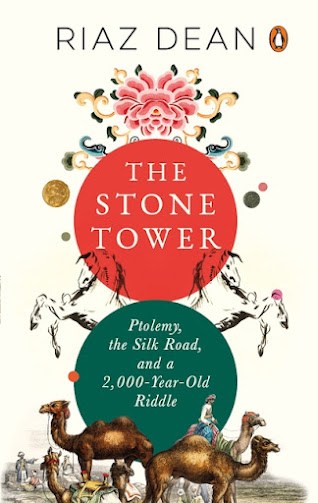
In the quest to resolve the 2,000-year-old riddle about the Stone Tower that Ptolemy had written about - the midpoint in the route linking Asia and Europe that was the most important landmark for travelers on the silk route - Dean retraced the Silk Road from Istanbul to Xi’an, and sifted through earlier descriptions in geographical search. The mid point remains important pivot on the Silk Road  because locating the elusive site would help capture the wider historical context for future excavations towards understanding the history of civilizations that existed along the route.

The Stone Tower is as much a book on ancient history and political intrigue, as much on geography and cartography, taking the challenge to mark the spot among a dozen mentions of a Stone Tower in Ptolemy’s a monumental atlas of the ancient world, Geographia. Though his vague description about the tower even misled Christopher Columbus, the clue that it was on top of a revered mountain did serve a crucial purpose. Narrowing his search down to four chioces, Dean examined the diverse functional requirements of the passing caravans in making a case for Sulaiman-Too  at 1,175 metres above sea level as the location of the tower, a clearly identifiable and permanent landmark close to the Chinese border. How the author finally arrives at the elusive site of the tower makes The Stone Tower a fascinating read.    

The origin and history of The Silk Road comes to life through three carefully crafted chapters, from the birth of the Silk Road to the historical events on its ascendency and control, leading to the establishment of the tower as the pivot that connected social, cultural, political, and geographical dots along the silk road. Backed by meticulous research, the erudite narrative on  the Silk Road presents the region as the progenitor of important inventions that powered then world economy. With China still leading the world in modern technology, and India with its philosophical riches, the history seems to be on the verge of repeating itself.

The Stone Tower covers almost 300 years of ancient history, from 140 BC when a Chinese palace guard had volunteered to travel west for his emperor to AD 140 when Ptolemy had probably completed his monumental Geograhia. It is that part of our shared history that augers well to redefine and realign the present. Dean succeeds in bringing to life 300 years of the bygone era, providing a wider perspective on our shared history. The book makes engaging reading in parts, as some sections will appeal more to history buffs. All said, the search for elusive Stone Tower makes a significant contribution to the literature on the Silk Road, offering a fascinating tale of archaeology and exploration. It is the romance for silk that brings the bygone era to life!

The Stone Tower
by Riaz Dean 
Penguin Viking, New Delhi 
Extent: 223, Price: Rs. 599.

First published in Deccan Herald on March 20, 2022.

Wednesday, March 2, 2022

The palm oil’s curse on life and the environment

The story of palm oil is the story of colonialism, armed gangsters, murderous executive, and corrupt politicians.

There are moments in life when doubts on closely held beliefs begin to surface, as truth gets distilled out of social delusion. It eventually guides us to hold our  assumptions to a deeper scrutiny. That is what award-winning journalist Jocelyn Zuckerman has succeeded  through her groundbreaking research, compelling the reader to examine the connections between the choices we make at the grocery store that keeps the  planet under siege. That palm oil’s overwhelming presence in soap and lipstick to baby formula and dog feed is the cause for persistence of poverty and hunger in other parts of world would unsettle any sane mind.

Having insinuated itself into every facet of our lives over the past few decades, palm oil alone counts for one-third of total global vegetable-oil consumption. With annual purchase of 9.2 million metric tones in 2019, India is the world’s number-one palm oil importer. Far from being a boon to the world economy, the multi-billion dollar palm oil business has been a bane instead. Our growing appetite has worsened the situation - more forests are cleared for new plantations, forcible evictions have escalated human sufferings; and enhanced carbon emissions remain the resultant outcome. Despite its long term health and environmental implications, the worrisome aspect is how a lesser-known oil suddenly became an indispensable consumer product? Did consumers really demand it, or had it somehow been the other way round?

Zuckerman unearths palm oil troubled colonial legacy to draw a parallel with its current fetishism, promoted by ruthless industrialization of our modern food systems. With multiple uses and an economic life of a quarter century, palm oil productive potential could not escape the attention of maverick George Goldie, credited for securing Nigeria for the Crown, and quirky businessman William Lever, for establishing oil-palm plantations in Congo, whose disturbing ways of the 19th century continue to loom large over the palm oil industry today. The story of palm oil is the story of colonialism, which is sinister in its present-day design involving armed gangsters, murderous executive, and corrupt politicians.  

Planet Palm is not only a disturbing expose on contemporary ills associated with the palm oil trade but holds unsuspecting consumers complicit in the corporate monopolisation of $65 billion global business. Trade liberalisation has contributed to this inconspicuous consumption, easing crossborder peddling of ultra-processed junk foods by multinational companies. ‘Part of the problem, ‘ explains Zuckerman, ‘is the sort of nutrient-deficient, heavily processed junk that all of this cheap oil enables’. And land planted with oil palm across the developing world, an estimated 104,000 square miles, is land which is diverted from growing healthy foods. Having traveled across four continents, from Indonesia to Honduras and from Liberia to India, the author is unsparing in her revelations, providing disturbing evidences on the world’s most environmentally damaging product – something most of us unknowingly use every day. 

It is an extraordinary work of investigative journalism that will make the discerning reader rush to look differently at the items stacked in its kitchen and bathroom. The collective power of consumer choices  is critical to turning things around as incidences of violence against those opposing the industry has grown – half of 212 eco-defenders reported killed in 2019 were opposing palm oil interests. Such intimately linked are national economies (those of Malaysia and Indonesia) to the palm oil industry that even the governments remain obliged to defend the commodity. What could be more shocking than the fact that France was diplomatically forced to drop plans for a tax on palm oil in 2016, as Indonesian government had made it clear that passage of the law might result in the execution of a French citizen then being held in Jakarta on drug-trafficking charges. Palm oil business is reviving the colonial-era historical horrors. 

Engaging, intriguing and disturbing, Zuckerman provides compelling account of the darkest underside of late-stage capitalism. While there is no denying that our food systems need overhauling, equally important for the consumers is to raise their voices to demand more transparency from the industry. Zuckerman leaves the reader with an optimist note to wean ourselves away from palm oil by using synthetic versions of the oil and convincing companies to adopt no-deforestation policies in their production codes.

Planet Palm is a riveting account blending history, science, politics, and food as seen through the lives of people upended by this hidden ingredient. Instructive and provocative, Planet Palm makes an essential reading for everyone who wonders if our food choices matter. 

Planet Palm 
by Jocelyn C. Zuckerman
Hurst & Co, London 
Extent: 335, Price: Rs. 1,606.

First published in the Hindu on Feb 27, 2022.